


By Agatha Ngotho | angotho@gmail.com
In Doldol, Laikipia County, climate change is no longer a topic of discussion in policy rooms. It is felt in the scorching sun, shrinking pasturelands and longer dry spells that increasingly threaten traditional livelihoods.
For generations, families across the Maasai community have relied heavily on milk and meat as their main source of food. But as droughts become more frequent and livestock productivity declines, this once dependable diet has grown increasingly fragile.
Today, women are turning small kitchen gardens into climate-smart lifelines and providing fresh vegetables, improving nutrition and creating new sources of income in an arid landscape.
For the Namelok Women’s Group in Doldol, Laikipia North, kitchen gardening began as an urgent response to worsening food insecurity.
“We started the kitchen gardens after seeing a real gap,” said Sylvia Namerae, the group’s treasurer. “Here, the main food is milk and sometimes ugali. But our children were falling sick often. We realised they needed vegetables and fruits to stay healthy.”
She explained that access to fresh produce in Doldol has long been a challenge, compounded by climate variability and distance to markets. Namerae added that the nearest market operates only once every two weeks, forcing families to buy vegetables meant to last for days under harsh conditions. “You buy vegetables and try to stretch them for two weeks, but they spoil after a few days because of the heat. Children end up going many days without vegetables,” Namerae explained.
As droughts lengthen and household incomes tighten, the women began exploring alternatives that could work within their environment. With training and technical support from the Food and Agriculture Organization (FAO) of the United Nations, they learned climate-smart farming techniques tailored for drylands.
The group adopted vertical gardens, biconical gardens and other water-efficient systems that require minimal space and conserve moisture.
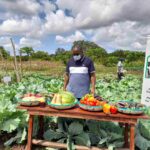
Soon, their Manyatta (communal homestead) was transformed into a demonstration site. Spinach, cabbage, managu, sukuma wiki and herbs now grow alongside fruits such as strawberries, dragon fruit, mangoes and avocados.
“These gardens have given us hope. Even when the rains delay, we still have food. In the near future, we want to ensure that each homestead has a kitchen garden to provide food and improve the nutrition of our families,” said Namerae.
Beyond food consumption, the gardens are opening new income opportunities. The women envision supplying nearby villages with fresh produce, reducing dependence on distant markets and strengthening local food systems that are more resilient to climate shocks. “Soon, people here will not need to buy vegetables from far,” Namerae said. “We will be selling fresh vegetables from our own gardens. It will put money in our pockets.”
For Elizabeth Kaparo, a single mother of four and a member of Namelok Women’s Group, the impact has been immediate.
“Before, I bought vegetables at the market on Fridays and hoped they would last until the next market day. After they finished, we just waited,” she recalled.
Today, Kaparo grows spinach, strawberries and blackberries right outside her home. “My children eat vegetables every day now. I don’t wait for the market. I just harvest,” she said with a smile.
The kitchen garden has reduced her household food expenses and shielded her family from climate-related food shortages. “I no longer worry about my children missing important nutrients,” she said.
According to Ann Mbutura, Natural Resource Management Programmes Officer at FAO Kenya, the Namelok Women’s Group is among 14 community groups supported under the Forest and Farm Facility (FFF) Resilience Project, which focuses on climate adaptation, livelihoods and natural resource management.
“In 2023, the group received a Sh3.1 million (US$24,000) direct beneficiary grant,” she said. “The funding helped them strengthen governance, diversify income sources and invest in climate-resilient activities.”
Beyond kitchen gardening, the group practices beekeeping, table banking and beadwork enterprises that are less vulnerable to climate extremes and provide financial buffers during droughts.
FAO also supported the women with training in leadership, financial management, record keeping and gender inclusion.
“Initially, there were no men in the group. Now they have seven, which has strengthened decision-making and labour sharing,” Mbutura noted.
Their village savings and loans scheme has grown to Sh900,000 (US$ 6,970) in savings and Sh600,000 (US$ 4,650) in active borrowings, enabling members to invest in water tanks, poultry and farming inputs.
Water harvesting has been especially transformative in a region where rainfall is increasingly unpredictable.
“In drylands, water is life. Every member now has a water tank. Without water harvesting, kitchen gardening would not be possible,” she added.
With support from local leaders, the group has secured five hectares of communal land that hosts beehives, demonstration gardens, fenced farming plots and a Manyatta meeting house for training and planning.
“This is what community resilience looks like,” Mbutura said. “They plant together, harvest together and support one another. Their unity is their strength.”
Looking ahead, the group aims to aggregate smaller self-help groups into a cooperative capable of exporting honey and beadwork, further diversifying incomes in the face of climate uncertainty.
Already nominated as an FAO Model Village, Namelok Women’s Group is demonstrating that small, climate-smart solutions can deliver outsized impact.
“From struggling to access vegetables to cultivating thriving gardens and businesses, these women have shown that even a small kitchen garden can become a powerful tool for climate adaptation, nutrition and economic transformation,” Mbutura concluded.