

By Catherine Tembo | cathytembo88@gmail.com
In the heart of Malawi’s Chibvala Village, Dowa district, the smell of fresh milk mingles with the earthy scent of cow dung drying under the sun. The air hums with quiet change. Once thick with smoke from burning firewood, it now carries the soft hiss of biogas flames flickering inside mud-brick kitchens.
For years, Lucy Denion, 45, spent her mornings walking long distances to fetch firewood. Charcoal was too expensive and the smoke from open fires made her eyes burn.
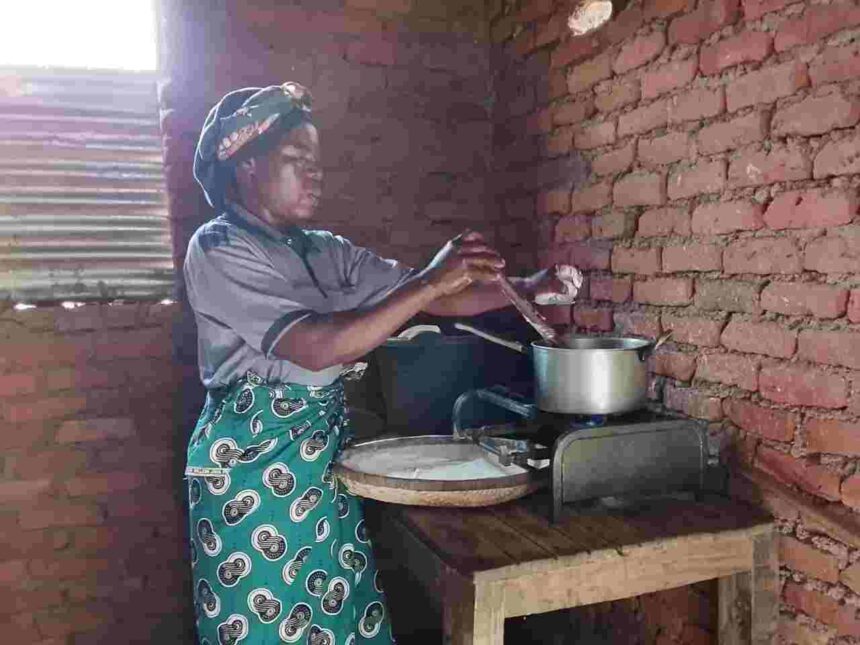
“Before we had biogas, we cooked only once a day because finding firewood was hard,” she said, smiling as she stirred nsima (a traditional meal) over a blue flame. “Now, I cook without smoke. I have more time for my family. Life is easier.”
Denion is part of Mbalame Dairy Farmers Group under the Chibvala Extension Planning Area. Using proceeds from milk sales, her family paid a deposit for a small biogas system. It was an investment that changed her daily life. But while her story glows with hope, it also highlights a hard truth: few Malawian farmers can afford to go green.
Biogas — a renewable energy source made from animal waste — promises clean cooking, less deforestation and better soil fertility. Yet the cost of installing a system remains far out of reach for most rural households.
“To install one, you need to be financially stable,” said Pretorius Msonthi, chairperson of the Mbalame group, which has 290 members and 252 dairy cows. “If you’re on a subsidy, you pay about K449,000 (US$259) over six months. Without it, the cost can reach K1.9 million (US$ 1,095). Most farmers can’t manage that.”
Msonthi himself uses a Sistema 12 biogas plant, which powers his home and produces biochar manure for his fields. “Many farmers want this, but without subsidies or affordable loans, it’s impossible,” he said.
Malawi’s biogas struggles mirror a global problem — the lack of investment in what experts call a just transition: a shift to cleaner energy that also protects workers, women and poor communities.
A new report by ActionAid International, “Climate Finance for Just Transition: How the Finance Flows,” found that only 2.8% of global climate finance supports projects ensuring fair and inclusive transitions.
Even more striking, only one in 50 projects meaningfully involves communities in decision-making. In practical terms, for every US$35 spent on climate action worldwide, only one dollar supports ordinary people adapting to change.
“The world urgently needs action to prevent climate breakdown,” said Arthur Larok, ActionAid’s secretary general. “But polluters — not poor farmers — should pay the price. Just transition approaches are severely underfunded and people’s needs remain at the bottom of the list.”
Teresa Anderson, ActionAid’s global lead on climate justice, said climate policies must focus on livelihoods, not just emissions. “Climate action should always put people and their needs first. That’s what we mean by a just transition.”
Some local companies are working to make biogas more accessible. Ecogyne Malawi, a renewable energy firm specializing in biogas and organic fertilizer, offers systems ranging from K1.2 million (US$ 692) to K5.2 million (about US$ 2,998), with subsidized prices as low as K249,000 (US$ 143) for small farmers.
“Biogas is a zero-carbon energy source that helps reduce deforestation,” said Mphatso Elizabeth Gama, the company’s partnerships and marketing manager.
“Every new plant installed means fewer trees cut down and fewer families relying on charcoal.”But Gama admitted that even with discounts, many farmers still can’t afford the upfront costs.
“We see high interest, but limited financing options. That’s what slows down adoption,” she noted. Clement Makuwa, programs manager for the National Youth Network on Climate Change (NYNCC), said low investment in renewable energy has ripple effects across the country.
“When biogas projects aren’t funded, families continue using firewood,” he said. “That means more deforestation, more respiratory illnesses from smoke and fewer opportunities for women and youth.”
Makuwa added that climate action cannot succeed if it excludes the rural poor. “If renewables remain unaffordable, we’re deepening inequality instead of solving it.”
As dusk settles over Chibvala, a soft blue light glows from Lucy’s kitchen window. The biogas flame burns steady — a small victory in a big fight against poverty and climate change.
Outside, other homes are dark, their owners preparing for another night lit by smoky wood fires.
Lucy looks at her biogas lamp and sighs. “I wish every woman here could have this,” she said. “We have the cows; we have the waste. We just don’t have the money.”
Her words echo a national reality — that the path to sustainability in Malawi is clear but costly.
Without stronger financing and inclusive policies, thousands of small-scale farmers will remain stuck between progress and poverty, light and darkness.
For now, the blue flames of Chibvala flicker as a promise — proof that with fair support and global commitment, the green transition can be more than just a dream.