

By Ruth Keah | rkeahkadide@gmail.com
Journalists covering climate change stories should rethink how they tell their stories by focusing on women as solution providers and change makers rather than victims.
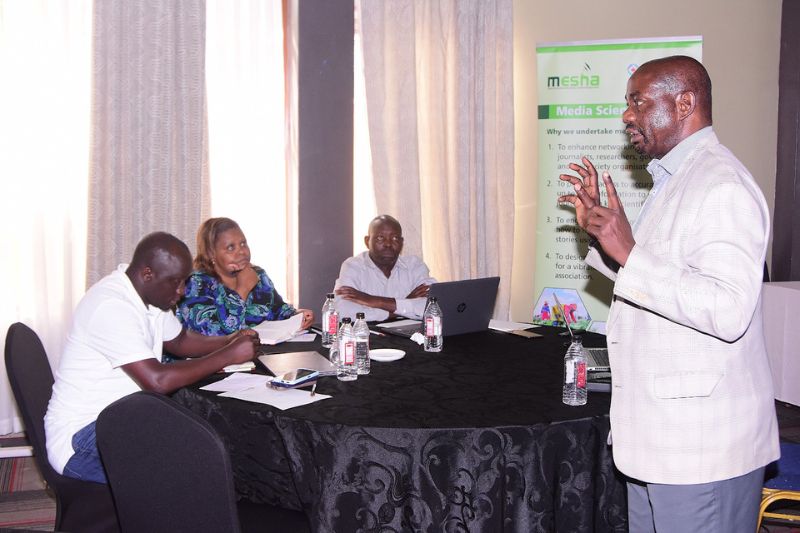
Speaking during the Cross Border Science Café Program organized by Media for Environment, Science, Health and Agriculture in Kenya (MESHA) under the theme “Reflections on climate change, gender, health and impactful stories,” communication and climate experts said the media has the power to shape not just public opinion, but policy and action.
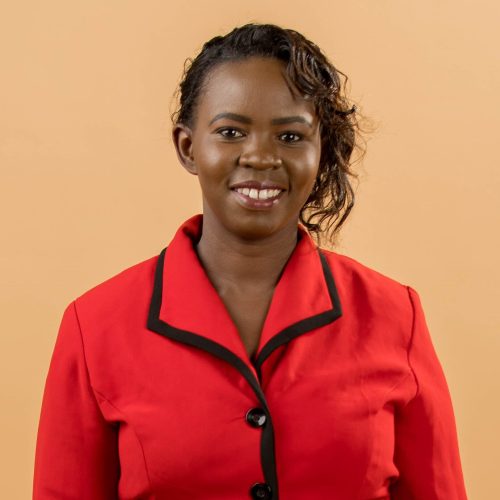
Audrey Masitsa, Regional Communication and Advocacy Coordinator at Mission Inclusion, said climate change is not gender neutral and neither should reporting be. “Women are at the center of these issues, but they are impacted very differently,” she said.
Mission Inclusion, a Canadian-based NGO working across Eastern and Southern Africa, runs the Regenerative Seascapes for People, Climate, and Nature (ReSea) project to strengthen the resilience of coastal communities in Kenya, Tanzania, Mozambique and Madagascar, with a focus on women and youth.
The project supports marine conservation, governance and the blue economy while applying a strong gender lens.
Masitsa said that in many coastal communities, climate shocks such as prolonged droughts, heavy rains and rising sea levels increase the burden on women.
“They are the carers at home. They fetch firewood, they look for food, they take care of children,” she said, adding that when forests are degraded or resources shrink, women must walk longer distances and work harder just to provide for their families.
Economic stress also spills into households. For example, when fishermen return with smaller catches due to changing ocean conditions, tensions can rise, sometimes leading to gender-based violence.
“One of the biggest gaps we see is that women are shown as beneficiaries or vulnerable people. But they are also leaders and problem-solvers,” she said.
Masitsa urged reporters to move beyond disaster headlines and focus on solutions and local agency. She encouraged journalists to let communities speak for themselves rather than relying only on experts or institutions.
“Quote them directly. Tell their lived realities. Their voices carry more weight than third-person reporting,” she added.
Drawing examples from the ReSea project, Masitsa explained how women are leading mangrove restoration efforts to mitigate climate change in Kenya’s coastal areas. They manage nurseries, sell seedlings and even produce mangrove honey through beekeeping.
Some have even joined beach management units and marine governance committees’ roles traditionally dominated by men. Masitsa urged journalists to use stronger angles while highlighting gender climate stories, noting that they should show leadership, not dependency.
Besides, journalists should connect local experiences to national and global policies, linking a woman farmer’s struggle to broader climate finance, adaptation plans and government decisions. “You have platforms that can bring these voices to the global stage. Those stories should inform the climate agenda,” she said.
Echoing her sentiments, Teresa Anderson, Climate Justice Lead at ActionAid International, said women’s groups are already influencing policy from the ground up.
She said across several countries, women farmers are forming coalitions, engaging local leaders and advocating directly to national governments for fair climate policies and investments.
“They are not waiting to be saved. They are organizing, leading and demanding change,” Anderson said. She urged governments to ensure climate plans include participation, social protection and justice for communities most affected.
Masitsa noted that when journalists tell these stories, they can reach the right people and make a real difference.
“By centering people, highlighting solutions and amplifying local voices, reporters can help turn climate coverage into a tool for change,” she said.