


By Milliam Murigi I healthjournalist3@gmail.com
Veronicah Ndetu, 62, resident of Kavuka village, Kilome sub-county, Makueni County, never imagined that some delicacies she once only ate in hotels or during major events would one day be growing in her backyard. For over two decades, her diet and farm were dominated by maize and beans, a pattern typical of households across the region.
But two years ago, Ndetu’s story took a turn when she was introduced to cover crops by an organisation promoting conservation agriculture.
“I used to only eat njahi (scientific name Lablab purpureus) and mbaazi (pigeon peas) in hotels. They were too expensive to buy for home consumption,” she says, smiling as she sorts freshly harvested green grams.
Cover crops are plants grown primarily to protect and enrich the soil as well as for harvest. They can be either edible or non-edible, providing both environmental and nutritional benefits to farming communities.
Since adopting them, Ndetu now grows njahi, pigeon peas, green grams, velvet beans (mucuna) and kunde (cowpeas) besides her maize and beans.
“The good thing is that they have diversified what we eat at home. We now have more nutritious meals and I even sell the surplus for extra income,” she says.
The shift has also revived her soil. Before, when the rains failed, she would harvest nothing. But these crops are drought-tolerant and help the soil retain moisture. Even when rain is little, Ndetu still gets something.
In nearby Itumbule Village, Jennifer Muli Nguti has also adopted cover crops. Besides, she has gone a step further- moving from village to village teaching other women to grow what she calls the miracle legumes. However, she admits, adoption remains slow.
“Women don’t own land. To plant cover crops, they must get consent from their husbands. Many men still prefer using the land for cash crops like maize or fruits,” she explains.
According to her, the issue is deeply tied to gender inequality in agriculture. Cover crops are often associated with women because they are the ones who focus on feeding the families. If women are not supported to grow them, the country will continue having malnourished children.
Kenya’s Ministry of Health data shows that counties like Makueni continue to record worrying levels of malnutrition, a crisis driven partly by poor dietary diversity.
As of April 2025, the County was caring for 950 children under the age of five diagnosed with Moderate Acute Malnutrition, a condition that, if left untreated, can have long-lasting effects on a child’s growth and development.
Jennifer urges men to view cover crops not as competitors but as complements. The reason is these crops do not need extra land, one can intercrop them with maize or fruit trees.
“The moment I realised beans are not the only legume I can grow, my household changed,” Nguti says. “Now we eat a variety of legumes rich in protein and minerals and I don’t worry about buying food from the market anymore. It’s amazing how much difference it makes.”
Her efforts are quietly reshaping gender norms. In a society where men have long dictated what grows on the farm, she is reclaiming agency through crops that not only feed their families but also heal the land. Her success is slowly inspiring a new wave of inclusivity in agriculture.
It is because of such efforts that not all men are standing on the sidelines. Some, like Simon King’oo from Kavilila Village still in Makueni, have become unlikely champions of diversity, proving that cover crops are not just women’s work but a shared pathway to resilient, climate-smart farming.
“Before, we planted only maize and beans,” he recalls. “Now I intercrop maize with pumpkins, mbaazi, kunde and sweet potatoes. The farm stays green almost all year round.”
For King’oo, the transformation is not just visible in the field. It is reflected in his family’s wellbeing too. His children are performing better in school and he believes good nutrition has contributed to this.

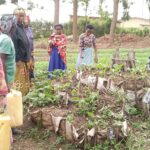
farming. | Photo Credit: Milliam Njeri
But why are organisations promoting cover crops adoption? Peter Kuria from the African Conservation Tillage (ACT) Network, a non-governmental organisation promoting conservation agriculture across Africa, says that they promote cover crops to improve household nutrition, increase organic matter in the soil, and enhance yields.
“We promote conservation agriculture based on three principles — minimum soil disturbance, permanent soil cover, and crop rotation or association. Cover crops are central to maintaining that permanent soil cover. The goal is to build resilient food systems while restoring degraded soils,” he says.
Kuria reveals that ACT promotes both non-edible cover crops like mucuna and cannavalia, which boost soil fertility, and edible ones like njahi, pigeon peas, cowpeas and green grams, which provide both nutritional and economic value.
According to him, these crops, especially legumes, enrich the soil by fixing nitrogen, making them a triple win in the fight against climate change, hunger and poverty. “When farmers get better harvests, they become food secure and can earn more income,” adds Kuria.
However, he notes that adoption of cover crop will remain slow as long as men continue to view cover crops as “women’s crops” and focus instead on cash crops. To change this mindset, he says, there is a need to build farmers’ capacity, improve seed access and leverage technology to connect them to markets.
Kuria believes technology will be a decisive catalyst. Value addition such as processing legumes into flour or snacks can create new market demand and motivate farmers. Digital platforms can also make seed access faster, easier and more affordable.
“It is important for farmers to integrate cover crops into their daily farming because they improve food security, soil health, and even social wellbeing,” says Caroline Kituku, the Ward Agricultural Officer for Kilome Sub-county.
Kituku has been training farmers on the benefits of cover crops and has witnessed firsthand how they help communities adapt to the effects of climate change. She explains that cover crops protect the soil from the scorching sun and strong winds, prevent nutrient loss, reduce erosion during erratic rainfall, and help the soil retain both moisture and fertility. Beyond protecting the soil, the crops contribute directly to nutrition and income.
“Some cover crops like sweet potatoes and legumes are food for the family, a source of income, and even fodder for livestock. They serve multiple purposes,” she says. However, Kituku acknowledges that cultural barriers remain.
“In the Kamba culture, women must seek consent from their husbands before planting certain crops. If men are not informed or involved, they may not give consent. That limits women’s participation,” she says.
Her office is working to change that through inclusive community training sessions. They ensure both men and women attend their sensitisation meetings, field days and demonstrations. Their goal is to reach at least 80 to 90 percent adoption in the coming years. Currently, adoption is at about 50 percent.
“Because of cover crop adoption, we’ve witnessed improved food security, reduced soil loss, and better soil fertility. Cover crops may seem like a small innovation, but they hold immense promise for Kenya’s drylands. They restore soils degraded by decades of monocropping, offer nutrient-rich food options and empower women who, despite limited land rights, play a central role in family nutrition,” Kituku says.