

By Kelvin Matuku I kevohwilson254@gmail.com
About eight kilometres from Kisumu town in western Kenya, along the Kisumu-Busia highway at Otonglo, Ustawi Organic Farms is turning discarded organic waste into agricultural products.
At the centre of the enterprise is Bella Kipruto, whose approach to circular economy aims to create opportunities for farmers, particularly women, to benefit from resources that otherwise go to waste.
“We are a circular economy business where we practise regenerative agriculture. We convert organic waste into farm inputs for horticultural farmers and insect protein for poultry and fish farmers,” Kipruto explains.
Women are central to Africa’s agrifood systems, yet their contributions are often undervalued. A 2025 report by the Food and Agriculture Organization of the United Nations on women in agrifood systems in sub-Saharan Africa found that women made up 49 per cent of the region’s agrifood workforce. However, many continue to face barriers to land, finance, training and markets, limiting their ability to grow agricultural businesses and benefit fully from their work.
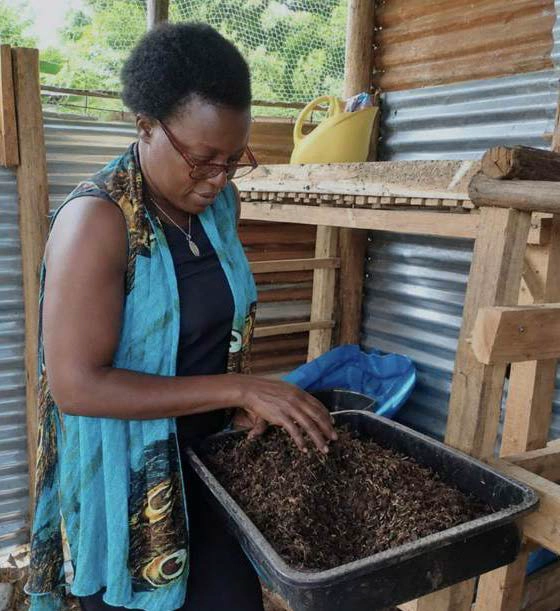
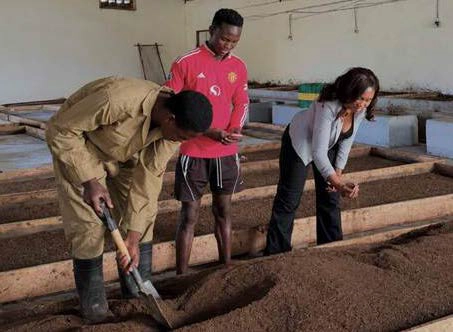
At Ustawi the process begins with organic waste collection activities. In Kasawino Mayatta market, ten women collect and sort the waste before it’s transported to the farm. “We take it to storage, grind and ferment it for five days before placing it in the larvae beds,” she explains.
The larvae feed on the waste as they grow. After processing the remaining material, known as frass, it is collected and used as organic fertilizer. The larvae are harvested for use as protein-rich feed for poultry, fish and pigs.
The fertilizer is sold to farmers growing vegetables and other crops, while the larvae provide an alternative source of animal feed.
The process aligns with regenerative agriculture which aims to restore soil health, protect biodiversity, and conserve resources. According to Food and Agriculture Organization (FAO) identifies nutrient recycling and converting food waste into fertilizer and animal feed as circular agrifood practices.
At Ustawi market waste becomes organic fertilizer and BSF larvae for animal feed. Report by Intergovernmental Panel on Climate Change (IPCC) notes that sustainable land management can reduce land degradation and support climate change adaptation and mitigation.
Ustawi processes about 40 tonnes of organic waste each week, produces 3.2 tonnes of Black soldier fly (BSF) feeds and generates 18 tonnes of organic fertilizer monthly.
At Otonglo farm, Kipruto shares, women are involved in collecting and sorting waste, while four young men help with processing. In Bondo, Ustawi operates an outgrower farm that produces seedlings and hatchlings, works with with five women and three men.
Beyond its direct production partners, Ustawi reaches about 180 additional beneficiaries through use its products and market linkage according to Bella.
The enterprise works with women growing green leafy vegetables in Kisumu, Kakamega, Vihiga and Nyamira counties. Through a partnership with Sikawa Circle, it also supports women farmers in Nyando.
Once the vegetables are ready for sale Ustawi collects the produce and helps women to take it to market. “We aggregate and sell the vegetables which gives our women access to markets,” she says.
The arrangement is intended to reduce the time and money women spend travelling to sell their produce. Many balance farming with household responsibilities and childcare, leaving them with limited time to pursue other economic activities.
Ustawi’s work has expanded beyond Kisumu. Kipruto stated that the enterprise currently serves farmers in 14 counties and has about 800 farmers. It aims to reach 5,000 farmers within the next two years.
Through programmes supported by YSA and the Mastercard Foundation, Ustawi has trained about 2,500 people in circular agriculture and BSF production. Kipruto has observed a shift of attitude towards organic waste and greater participation in economic activities.
“I’ve seen a change in income among the women and a change in their attitude towards organic waste. They no longer see it as waste but as a resource because it’s putting money in their pockets,” she says.
Evelyne Adhiambo, a farmer in Awasi who uses Ustawi’s products, the training improved her management of poultry and vegetable farming.
Adhiambo credits Kipruto introduced her to BSF technology after she realized how much she was spending on commercial poultry feed bought from agrovet shops. But now producing BSF larvae supplements the feed for her local chickens, commonly known as kienyeji and uses organic fertiliser on her vegetable farm.
“I keep local chickens, and people give me feedback that my chicken is very tasty. For now, I have 100 per cent relief and no stress about chicken feed anymore,” Adhiambo noted.
Although she has not started selling BSF larvae, Adhiambo uses them to feed her chickens and has built her own production setup. She says the high cost of travelling between Awasi and Otonglo made her buy materials and build a cage to produce larvae herself.
Beyond poultry, Adhiambo says Ustawi has helped other women farmers in Awasi access markets for their indigenous vegetables. After receiving training, she began training other women in vegetable farming.
“About a month ago, Kipruto took two full sacks of vegetables. This has us helped in reducing transport costs and also access markets that I’m unable to access,” Adhiambo notes.
Adhiambo estimates that before adopting BSF technology, she spent about Ksh 4,000 on commercial poultry feed. She now spends between Ksh 1,000 and Ksh 1,500 a month on rice jam, supplementing it with BSF larvae for her 100 chickens. She says the change has eased the financial pressure of keeping poultry.
Despite these benefits, Adhiambo says access to land remains a challenge for her and the group she works with. Demand for their produce has increased, but their farms are too small to meet it. Water shortages during dry seasons also make irrigation difficult.
Ruth Ojoyo, a poultry farmer in Maseno, reports changes since adopted Ustawi’s poultry feed. A user of the product for three months, Ms Ojoyo have noticed improvements in her chicks’ growth and health.
“My chicks grow very fast and are healthy. The cost of feed has also changed up to now. I am waiting to receive new products, which I hope will bring further changes,” Ojoyo adds.
While the farmers describe benefits from the products, agricultural extension officer Timothy Njagi shares the effectiveness of BSF fertiliser depends on its nutrient composition, soil health and the crop being grown.
“Farmers’ productivity depends not only on fertiliser but also on soil health, nutrient availability and understanding how to apply agricultural inputs,” he explains.
Njagi notes that circular agriculture could help smallholder farmers who struggle with the cost of agricultural inputs, provided they have access to organic waste, basic equipment and the technical knowledge needed to manage the process. However, limited agricultural knowledge and inadequate extension services can make adoption difficult.
According to Humphrey Jumba, a research officer and gender expert at the International Livestock Research Institute (ILRI), a CGIAR research centre, women face additional barriers in crop and livestock production.
They often have limited access to improved livestock breeds, quality feeds and forages as they carry much of the responsibility for animal care and collecting feed and water.
“Cultural norms around mobility and decision-making have also constrained women when negotiating the sale of harvests and livestock, exposing them to exploitation by middlemen and limiting their autonomy over income,” Jumba explains.
Access to finance is another challenge. Women who do not own land may struggle to obtain loans because lenders often require assets as security. Jumba says training in financial management can help, but it cannot by itself resolve unequal access to land and household resources.
Jumba says agricultural programmes should look beyond the number of women trained or involved in production. They should also assess whether women have gained access to resources and whether they can make decisions about their businesses and earnings. He points to the Women’s Empowerment in Agriculture Index as one tool for assessing women’s empowerment in agricultural activities.
Kipruto argues that adopting the Ustawi model requires training in agroecology and circular agriculture, as well as financial management skills to run businesses and reinvest their earnings. They also need access to capital and markets.
“The biggest barriers for women adopting this model are socio-cultural practices, including the need for permission from husbands, and limited access to land and decision-making power,” she adds.
Kipruto notes that training programmes consider the demands on women’s time, including childcare and household responsibilities. Kipruto also calls for changes in policies and practices that limit women’s land ownership and participation in decision-making. She believes men should be included in training do they understand how women’s economic activities can benefit the household.
Adhiambo experience illustrates how access to training and lower cost agricultural inputs can ease some of financial pressures of farming. However, whether such benefits translate to sustainable livelihoods depend on other factors including reliable markets, access to finance and the ability to decide how earnings are being used.
As the International Year of the Woman Farmer 2026 draws attention to women’s role in agriculture, Kipruto, through her Ustawi initiative is working to find answer to the pertinent question are women simply participating in agricultural activities, or are they acquiring the resources and gaining the decision-making power necessary to make positive change in society through agriculture.