


By Milliam Murigi | milliammurigi@gmail.com
Last week, Kenyan scientists, policymakers, farmers, and private sector players gathered in Nairobi for the Second Scientific Conference and Innovation Exhibition by the Kenya Agricultural and Livestock Research Organization (KALRO).
Under the theme Innovating towards Resilient Agri-food Systems for Climate Action, Food Security and Sustainable Livelihoods the aim of this conference was to close the gap between scientific innovation and the realities faced by farmers.
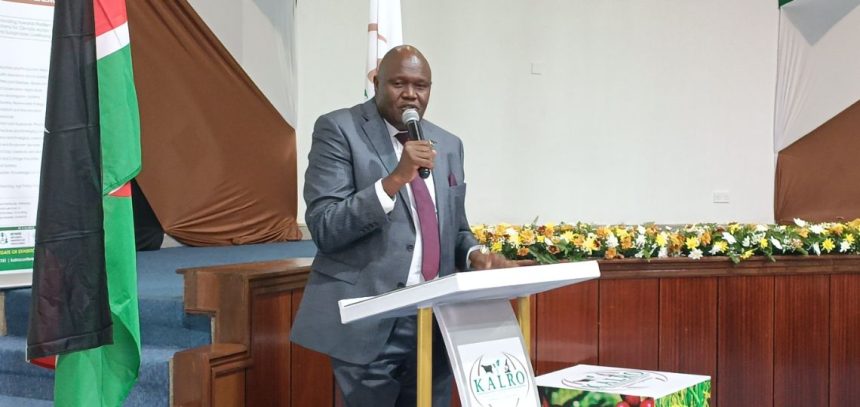
Speaking during the official opening of the meeting, Kenya’s Agriculture Principal Secretary, Dr. Paul Ronoh, told researchers to move beyond laboratories and deliver innovations to farmers who are struggling with climate change, food insecurity and rising production costs.
“You spend too much time in the lab and you have written too much. Shelves are full of scientific reports, but farmers do not know about the contents of your sweat because communication is weak,” he said.
The PS said many research findings remain confined to shelves and academic discussions while farmers continue struggling on the ground.
He urged scientists to simplify the way they communicate research findings and tailor information to appeal to ordinary farmers, many of whom lack access to smartphones, internet services or television.
He also stressed the importance of strengthening agricultural extension services to bridge the gap between research institutions and farming communities.
KALRO Director General, Dr. Patrick Keteim, said that the conference came at a critical time when Kenya is searching for practical solutions to tackle poverty, climate-related challenges, high production costs and post-harvest losses.
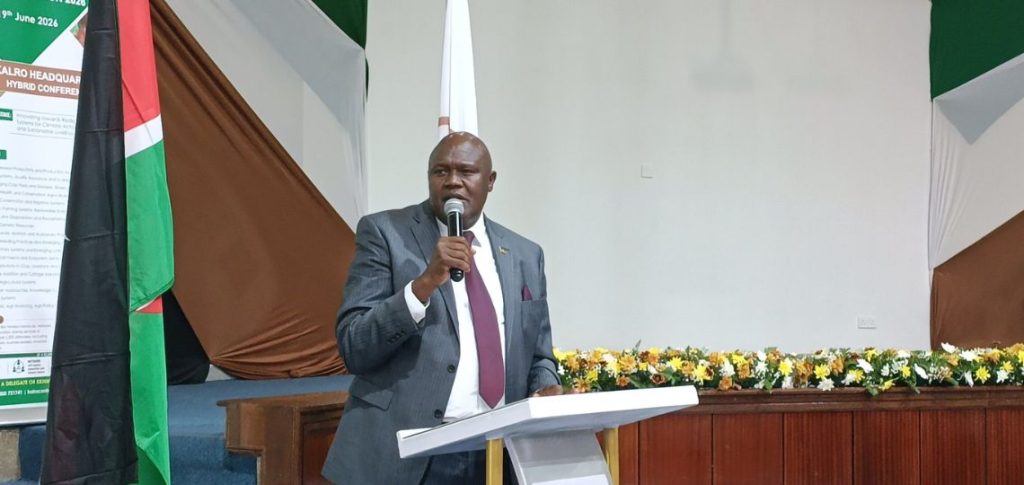
“As an institution, we remain committed to generating knowledge and developing technologies and innovations that transform the agricultural landscape while improving food security, nutrition, incomes and community resilience,” Dr. Keteim said.
He also acknowledged that there remains a significant disconnect between scientific research and the realities faced by farmers.
“It seems there is a complete disconnect between what is happening in research institutions and the realities on the ground among farmers,” he said, noting that the conference was intentionally designed to bridge that gap.
He emphasized that the scientific conference was not merely an academic gathering but a platform focused on delivering practical impact for farmers and agribusinesses.
The conference featured 17 sub-theme areas covering life sciences, biotechnology, digital agriculture, mechanization, climate-smart agriculture and other emerging fields shaping modern farming systems.
A major focus of the discussions was understanding why many research innovations fail to reach farmers despite significant investment in science and technology.
“This is not a trade show. This is where science becomes tangible, where people can see, touch and interrogate innovations developed by scientists,” he said.
Dr. Ronoh further called for increased investment in mechanization and farmer cooperatives to reduce dependence on manual labour and improve productivity.
He warned that food insecurity should be treated as a national security issue, arguing that hunger can destabilize communities faster than traditional security threats.
“Farmers are tired of manual work. Mechanization should be discussed seriously, but because tractors and machinery are expensive, cooperatives will be important for sharing resources,” he said.
“If there is no food, even security becomes difficult. Food security is real security,” Dr Rono added.
©MESHA Features 2026