

By Violet Otindo | violet@meshascience.org
Stories of men and women tilling land and working on their farms for months only to be rewarded with crop failure or the entire farms under crop being swept away by floods are no longer new in Africa.
But there have been more ways in which extreme weather, including heat waves, has affected human health. In some circumstances children have either risked or been married off to help their families survive dire situations. They sound like mere tales, until you get to the ground, and realise that climate change is no longer a phenomenon at your doorstep but a disaster right inside your house, your stomach, your lungs and even your head.
Aware that the resultant food insecurity, or nutrition related illnesses, especially among children, abound, your favourite science media association, MESHA presents to you 14 stories that capture the scenario in Africa.
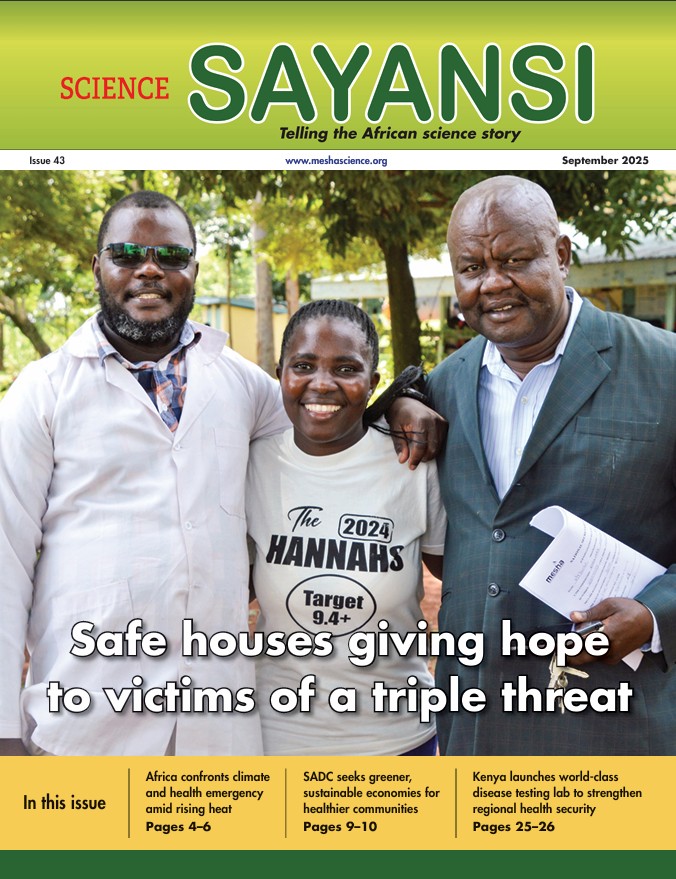
The September 2025 issue of Sayansi Magazine: (https://meshascience.org/wp content/uploads/2026/03/MESHA_43.-Sayansi-Magazine_September-2025.pdf) explores the growing intersection between climate change and public health across Africa, with stories from Kenya, Zambia, Malawi, and Zimbabwe.
This edition highlights how communities are experiencing and responding to climate-related challenges—from rising heat and disease outbreaks to food insecurity and shifting health systems.
Featuring in-depth reporting on HIV prevention, climate-induced health risks, and grassroots resilience, the articles amplify local voices and innovative solutions that go beyond vulnerability narratives. They showcase how communities, scientists, and policymakers are working together to build sustainable, health-centered responses to emerging challenges.
This issue not only informs but also inspires action, reinforcing MESHA’s resolve to tell the African science story in a manner that is shaping public understanding and policy engagement.