


By Agatha Ngotho I angotho@gmail.com
When the rains began to fail more often than they came, Doris Kanario knew she needed an income source that could survive drought as reliably as her perseverance.
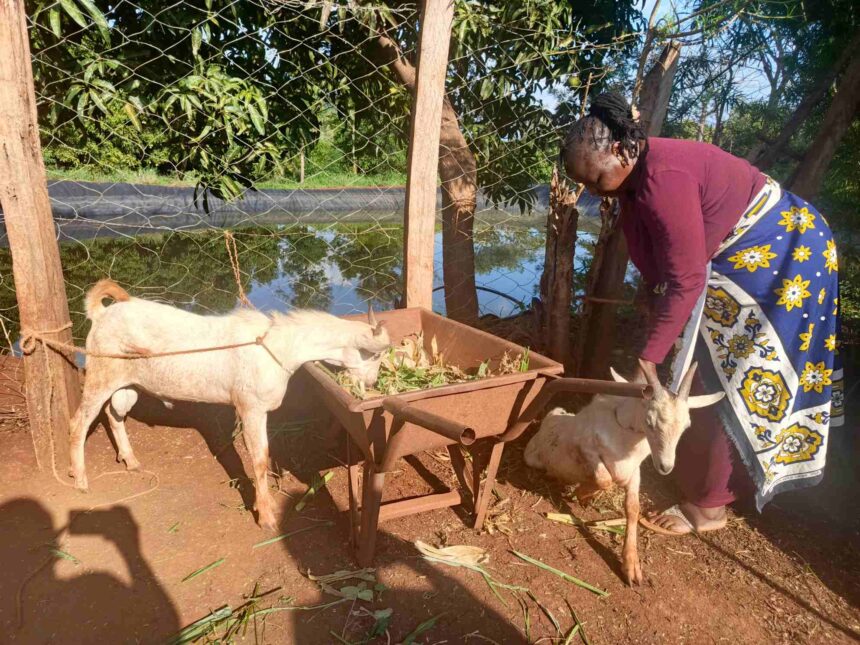
A widow and mother in Tunyai, Tharaka Nithi County, Kanario had always kept a few goats scattered behind her compound. But it was not until she joined the Umoja Women Self-Help Group that she saw dairy goat farming as a lifeline in a warming and increasingly unpredictable climate.
“I already had one or two goats,” she recalls. “But I wanted to learn how to do it better and I wanted to belong to something that would help me move forward.”
Today, Kanario owns four goats, though only one is of pure dairy breed. The cost of quality animals is her biggest hurdle. A pure dairy kid below three months costs between Sh15,000 (US$ 116) and Sh30,000 (US$ 232), far beyond what many rural women often surviving on casual labour can afford.
“A rural woman who is not earning anything cannot just wake up and buy a pure dairy goat,” she says. Like many women in the group, Kanario depends on table banking, small loans and the unity within Umoja to progress.
She says a good dairy goat produces one to two litres of milk a day, even under dry conditions when cows struggle. Kanairo keeps half a litre for her family to boost nutrition and sells the rest for income. “Goat milk has value,” she says. “And the manure helps me reduce the cost of chemical fertilisers.”
The region has witnessed a rise in temperature and prolonged dry spells, echoing national patterns. According to Kenya Meteorological Department assessments, the country has warmed by about 1°C over the past 50 years, with arid and semi-arid counties among the hardest hit. In many parts of Eastern Kenya, livestock losses during recurring droughts have risen by more than 20 percent in the last decade.
But goats endure what cows cannot. “When it is dry, cows suffer,” Kanairo notes. “But goats manage. They never go hungry.”
For Purity Gatiria, the coordinator of Umoja Women Self-Help Group, the shift to goats was not a trend but an act of survival.
“Our rains are not reliable anymore,” she says. “Every season comes with fear, will the crops fail, will the cows survive? But the goats have become our safety net.”
The group comprising of 30 members (25 women and five men) uses dairy goats to shield themselves from climate shocks while improving food and nutrition security. Even with land sizes shrinking and crop yields dropping, goats fit easily into small homesteads and feed on twigs and leaves.
However, Gatiria confirms that the biggest struggle is maintaining pure breeds. Years ago, the group received several good quality goats under a donor project but only one breeding he-goat. Soon, interbreeding diluted the quality.
“We mixed dairy goats with local he-goats because we had no alternatives,” she recalls. “The milk reduced and the goats lost market value.”
Despite these setbacks, dairy goats remain the group’s strongest buffer against climate risks. Their wish is simple: affordable pure breeds, reliable breeding services and more continuous training.

“We love goat rearing,” Gatiria says. “If someone can help us access pure breeds and good training, we believe we can transform our homes completely.”
The Women Farmers Association of Kenya (WoFaK) is among the organisations walking alongside groups like Umoja, ensuring rural women are not left behind as climate impacts intensify.
According to Daphine Muchai, the Executive Director of WoFaK, supporting women in climate-vulnerable regions begins with helping them make stronger decisions on food production, access markets, and influence policy.
“We help them sit at platforms where their voices can shape policies,” she says. WoFaK links women to opportunities in dairy goats, peanut butter processing, vegetable value chains, and even specialised programmes for women living with disabilities.
Leadership and governance training is central because resilient groups must remain cohesive—especially when climate shocks threaten incomes and food supplies.
Muchai notes that the agricultural sector, which employs over 70 percent of rural women in Kenya, is facing increasing pressure from rising temperatures and erratic rainfall.
Yet many of these women do not own land, livestock, or financial assets. “That is why we build their capacity,” she says. “We want women farmers to be seen, heard, and supported at all levels.”
At county chapters, WoFaK’s Rural Women’s Day creates space for women to showcase innovations, lobby governments and discuss food resilience in the face of climate stress.
Emily Makembo, Tunyai, Assistant Chief, has watched the dairy goat project become a pillar in homes struggling with reduced crop yields and rising food prices.
“These groups have grown in very important ways,” she says. “They help women support each other at a time when climate change is making everything harder.”
Makembo explains that drought used to send families far in search of milk. Today, dairy goat milk circulates within the village, strengthening nutrition for mothers and children. “Even my own mother benefits, she has goats too,” she says. “This project has brought mothers together, and you can see the difference even in their children.”
She believes dairy goats are more than an income stream. “They give dignity, independence, and resilience,” she explains. “Women here are not waiting for anyone to save them. They are organising, learning, and adapting to survive.”