

By using this site, you agree to the Privacy Policy and Terms of Use.
Accept
MESHAMESHAMESHA
  • Home
  • Who We Are
    • About
    • Management
    • Strategic Plan, 2023-2027
  • Sayansi Magazine
  • Media
    • Audio
    • Videos
    • Photos
  • Membership
    • Accredited Members
    • How to Join MESHA
  • IFAJ Congress
    • IFAJ 2025 Congress Website
    • IFAJ 2025 Congress Bulletin
Search
Categories
  • Climate Change
  • Health
  • Biodiversity
  • Agriculture
  • Environment
© 2024 MESHA. All Rights Reserved.
Reading: Innovations that spur fruit farming in eastern Kenya
Share
Sign In
Notification Show More
Font ResizerAa
MESHAMESHA
Font ResizerAa
  • Home
  • Who We Are
  • Sayansi Magazine
  • Media
  • Membership
  • IFAJ Congress
Search
  • Home
  • Who We Are
    • About
    • Management
    • Strategic Plan, 2023-2027
  • Sayansi Magazine
  • Media
    • Audio
    • Videos
    • Photos
  • Membership
    • Accredited Members
    • How to Join MESHA
  • IFAJ Congress
    • IFAJ 2025 Congress Website
    • IFAJ 2025 Congress Bulletin
Have an existing account? Sign In
Follow US
© 2024 Mesha. All Rights Reserved.
MESHA > Blog > Agriculture > Innovations that spur fruit farming in eastern Kenya
AgricultureInnovation

Innovations that spur fruit farming in eastern Kenya

Mesha
Mesha Published 30 March 2026
Share
2 Min Read
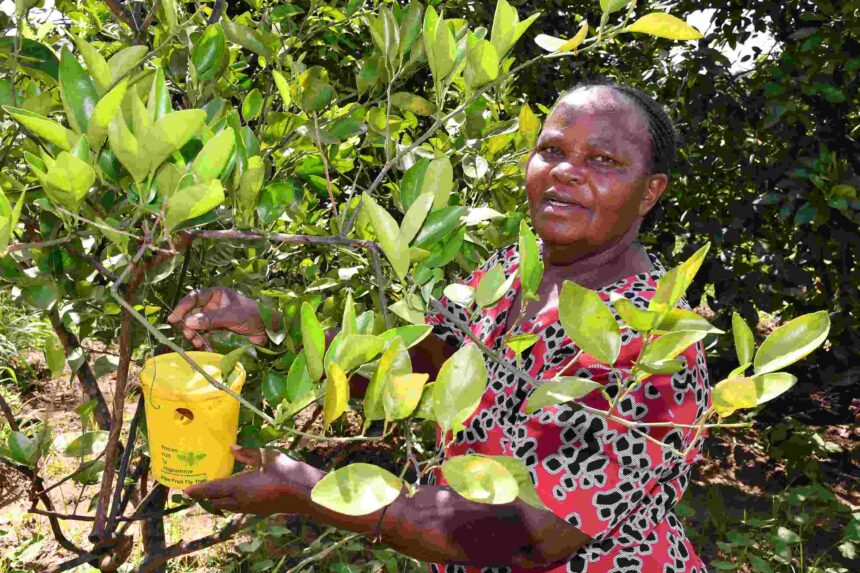
Mrs Phyllis Nduva demonstrates the use of an Integrated Pest Management (IPM) fruit fly trap in her orchard in Makueni County, Kenya—an innovation helping farmers reduce crop losses. | Photo Credit: MESHA
SHARE

By Christine Ochogo | christawine@yahoo.com

In the semi-arid lands of Makueni County which lies roughly 100-150 km South-East of Nairobi, Kenya, fruit farming is a key source of livelihood.

The county leads in mango production in the country with a total of 4.3 million mango trees grown by nearly 28,000 farmers.

According to Maarifa Centre, which operates under the auspices of the Council of Governors (CoG), Kenya, approximately 70 per cent of households in Makueni County engage in mixed fruit farming (mangoes, citrus, Avocado and other fruits) with over 70,000 households relying specifically on mango production as of 2023.

However, pests and post-harvest losses have long threatened farmers’ incomes resulting in economic losses of over Ksh 72 billion yearly (approximately US$ 550 million).

The Centre for Agriculture and Bioscience International (CABI) 2019 scientific report The Global Burden of Crop Loss, indicates that up to 40 percent of crops are lost annually to pests before they are even harvested.

In addressing this challenge, farmers in Makueni County are embracing innovative solutions to boost fruit production and reduce losses.

Among them is Mrs Phyllis Nduva, a fruit farmer who has embraced organic farming and uses Integrated Pest Management (IPM) in her 20-acre orchard, while minimising economic, health and environmental risks.

This initiative is gradually being emulated by some farmers who are abandoning the use of synthetic chemicals and fertilizers on their farms.

For more information please watch the video herein: [https://youtu.be/N4ZSFioVo6o]

You Might Also Like

COP27: New report urges innovative building solutions as Africa’s response to reducing greenhouse gases

Urgent action needed as pesticide misuse and climate change threaten Kenya’s food security

Joy in western Kenya as farmers abandon tobacco for beans

World Seed Congress: Lobbyists call for partnerships to drive uptake of seed varieties.

Malawi seed sector amplify support for biotech

TAGGED:agribusiness Kenyaagricultural development AfricaAgricultural Innovation Kenyaagriculture solutions Kenyaavocado farming Kenyacitrus farming KenyaClimate-Smart Agriculture Kenyacrop loss Africafarmer innovations Africafarming technologies AfricaFood Security Kenyafruit farming Kenyafruit production Africahorticulture Kenyaintegrated pest management KenyaIPM farming AfricaMakueni County agriculturemango farming Kenyamango value chain Kenyaorganic farming Kenyapest control farmingpost-harvest losses Africarural livelihoods Kenyasmallholder farmers Kenyasustainable agriculture Africa

Sign Up For Daily Newsletter

Be keep up! Get the latest breaking news delivered straight to your inbox.

By signing up, you agree to our Terms of Use and acknowledge the data practices in our Privacy Policy. You may unsubscribe at any time.
Share This Article
Facebook Twitter Whatsapp Whatsapp LinkedIn Email Copy Link Print
What do you think?
Love1
Sad0
Happy0
Sleepy0
Angry0
Dead0
Wink0
Previous Article Scaling science journalism at Maseno University
Next Article Weak policy delivery leaves millions at risk of hunger in Africa
Sayansi Magazine edition on how communities are responding resiliently to climate change now out
Climate Change Sayansi Magazine
Sayansi Magazine – Edition 45
Climate Change Development Gender Sayansi Magazine
Where residents fate relies on the hands of filthy water pans and bowsers
Climate Change Gender Health
MESHA introduces effective writing of science among students
Education Media|Journalism Sayansi Magazine

Contact Info

Location
Oasis Apartments, Jogoo Road, 3rd Floor
Phone
+254 721 578517
+254 732 229 230
info@meshascience.org

Facebook

//

We are the number one science, health and agriculture journalists network in Africa accessed by over 20 million users.

Quick Link

  • About
  • Sayansi Magazine
  • Accredited Members
  • Mesha Audio
  • My Bookmarks

Top Categories

  • Climate Change
  • Health
  • Biodiversity
  • Agriculture
  • Environment

Sign Up for Our Newsletter

Subscribe to our newsletter to get our newest articles instantly!

MESHAMESHA
Follow US
© 2024 MESHA. All Rights Reserved.
Join Us!
Subscribe to our newsletter and never miss our latest news, podcasts etc..

Zero spam, Unsubscribe at any time.
Welcome Back!

Sign in to your account

Username or Email Address
Password

Lost your password?