

By Catherine Tembo | cathytembo88@gmail.com
At 6 a.m, when dawn is still rubbing sleep from its eyes, Nora Basiwell used to slip out of her mud-brick kitchen with an empty sack slung over her shoulder.
The 59-year-old from Ntandile village would disappear into the forest before most roosters crowed, walking deeper and deeper into the thinning woods in search of the one thing her family desperately needed: firewood.
Some days her trek lasted hours. Some days she returned empty-handed. But every day, her children waited—hungry, anxious and often late for school.
“My children used to cry in the morning,” Basiwell remembers, her voice soft but steady.
“They waited for me to bring firewood so I could cook before they went to class. Sometimes they missed lessons because I came back late.”
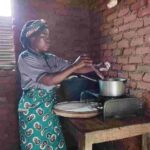
Her kitchen was thick with smoke, the kind that clung stubbornly to her clothes and stung her eyes until tears streamed down her cheeks. She cooked every meal on three stones and every meal felt like a sacrifice.
“Every day I cooked with tears in my eyes,” she says. “The smoke was everywhere. I felt like I was breathing fire.”
The coughing fits worsened. Eventually, a doctor delivered the truth she had long suspected: the smoke was damaging her lungs.
But what choice did she have? Firewood was all she knew. Nora’s story is shared by countless women in Malawi—women whose daily battles with smoke, forest depletion and chronic illness remain largely invisible.
According to the National Energy Compact for Malawi (2024), clean cooking encompasses the use of improved cook stoves, electric cooking (e-cooking), biogas, liquefied petroleum gas (LPG), bioethanol and briquettes or pellets.
Currently, only 2% of households utilize clean fuels for cooking. Female-headed households tend to use three-stone and traditional biomass stoves more frequently than male-headed households, which primarily rely on charcoal and cleaner stoves.
Over 97% of households depend on unsustainable firewood and charcoal for cooking, which is the dominant energy source in the country.
Hawa Tchasi, 55, runs a small doughnut business. Her kitchen was her workplace and smoke was her constant companion.
“I used firewood every day, and the smoke made me cough every 30 seconds,” Tchasi says.
“The doctor told me it was because of the closeness of the smoke in the kitchen.”
Her cough grew so persistent that she made several clinic visits. Each time, she received the same warning: the smoke was slowly suffocating her.
Then, in 2024, everything changed.
Basiwell and Tchasi joined the Ntandile Women’s Club, a group that has now grown to 32 determined members, where they learned something that felt almost miraculous: how to turn waste into clean energy—biogas.
Dr. Suzgo Kaunda from the Malawi University of Business and Applied Sciences explains that when animal waste, human waste, or food waste is left to rot in the open, it naturally releases methane directly into the air hence biogas systems trap the methane produced during anaerobic digestion.
Ntandile Group A, made up of 32 women, uses biogas for cooking in their homes. Concern Worldwide, a global non governmental organization, trained and purchased a biogas plant for the group.
The women collect waste from nearby markets and begin by sorting it— separating plastics and metals from organic materials.
They remove acidic waste like onions and lemons because it can kill the bacteria needed for biogas production.
The organic waste is then ground and mixed with water before being poured into the digester, where bacteria break it down to produce biogas. Once enough gas builds up, it flows through pipes and is used for daily cooking.
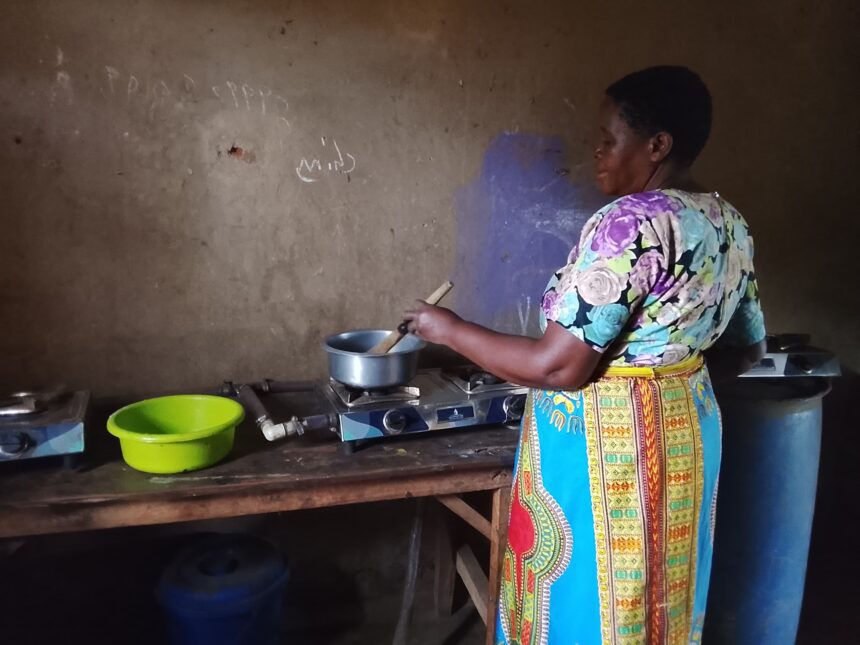
For the first time in years, Tchasi cooks without coughing. Basiwell no longer spends her mornings combing the forest for firewood. Their homes are cleaner, their breathing lighter and their time—once swallowed by smoke and wood—returned to them.
“I’ve seen improvement,” Tchasi says. “I don’t cough often anymore.”
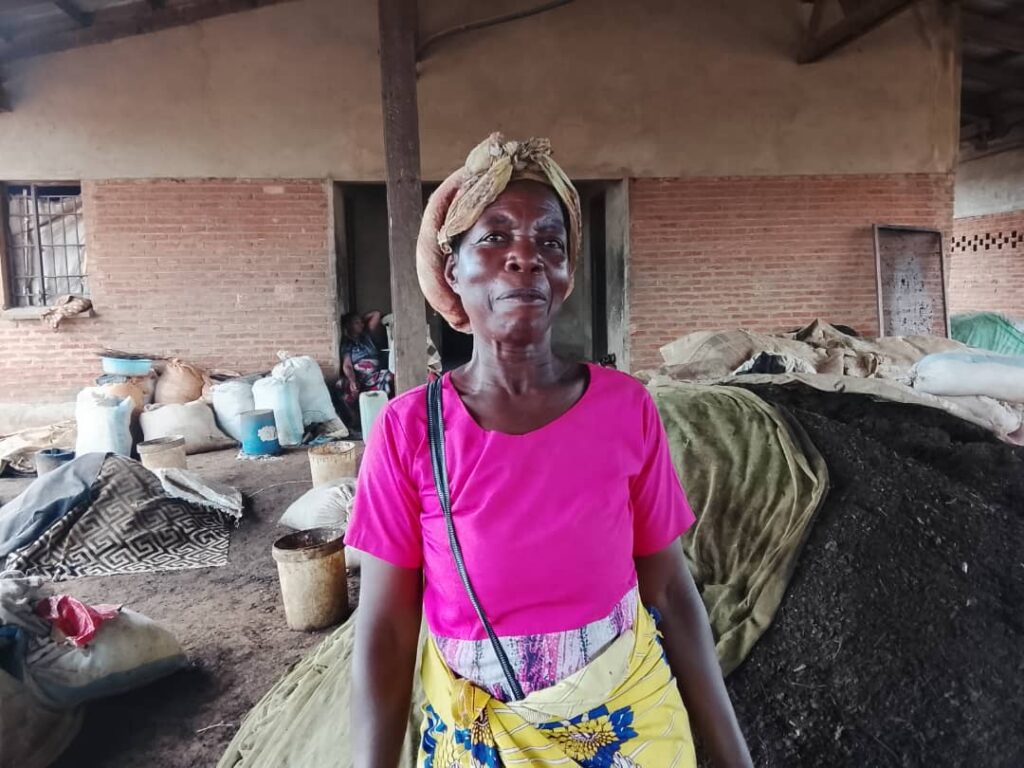
But the innovation didn’t stop at clean cooking. With the skills they acquired, the women began producing compost manure for sale—transforming what used to be household waste into a profitable business.
“We produce manure for business,” Tchasi says proudly. “Ever since biogas was introduced, things have changed.”
Last year, the group earned K10 million (US$ 5,765) from manure sales. This year, they expect to surpass it. The income now pays school fees, buys food, and supports households—proof that clean energy can be both a climate solution and a poverty solution.
Malawi is one of the poorest countries in the world, however, for some Malawians access to financing to build the biogas plants is a big problem, especially for small-scale farmers or community-based initiatives.
For decades, women and young people have been cast mainly as victims of climate change. But in Ntandile, these same women are offering real, practical solutions.
Biogas reduces deforestation. It cuts carbon emissions. It gives families back their health and time. And it turns rural women—long ignored in climate policy—into energy innovators.
During the 30th United Nations Climate Change Conference of Parties (COP30), global conversations circled around fossil fuels and the elusive roadmap toward a phase-out.
Teresa Anderson, ActionAid’s Global Lead on Climate Justice, stressed that energy transitions must not erase people. “Just transition approaches put steps in place to protect people and their rights,” she said. “It’s time for climate action to evolve and put people at the Centre.”
COP 30 amplifies communities to push for a Just transition and inclusive energy agenda, ensuring that no one is left behind as the world accelerates toward sustainable development.
Energy experts in Malawi echo this. Maxson Chitawo, Mzuzu University Senior Lecturer, says biogas is one of the simplest, most accessible clean-energy solutions available.
“It uses waste materials to produce gas for cooking and lighting,” he explains.
Kaunda notes that installation fees remain a barrier for many rural communities. “We need to invest more in such initiatives,” he says.
“More training is needed to address challenges.” He further said biogas helps reduce global warming because it captures methane before it escapes into the atmosphere.
Malawi government says it conducted research at household level which showed concerns about feedstock, prompting civic education efforts.
“Currently, the ministry has a dedicated division that looks at energy for cooking,” explained Joana Thaundi, Ministry of Energy spokesperson.
The 2018 Energy Policy is now under review, and the new version will include specific biogas targets.
As evening settles over Ntandile, Basiwell and Tchasi light their homes with ease—no smoke, no coughing, no frantic dawn journeys into the forest.
A quiet dignity has returned.
But beyond their homes, other women still walk dusty paths with heavy bundles of firewood balanced on their heads. Their lungs still burn. Their mornings are still swallowed by smoke.
This is the uneven truth of Malawi’s energy transition. Real progress is happening—but only when every woman can breathe clean air, save her time, and choose a future not defined by smoke.
Ntandile has shown what is possible. Now the country must decide how far this flame of change will spread.