

By Agatha Ngotho | angotho@gmail.com
In Nyakach, Kisumu County in Kenya’s western region, women are safeguarding indigenous seeds to protect the community’s heritage and resilience in an era of worsening climate shocks. With 108 members, 25 direct shareholders and 83 indirect beneficiaries, the Agoro Kabudi Community Seed Bank is conserving, protecting and multiplying indigenous seeds.
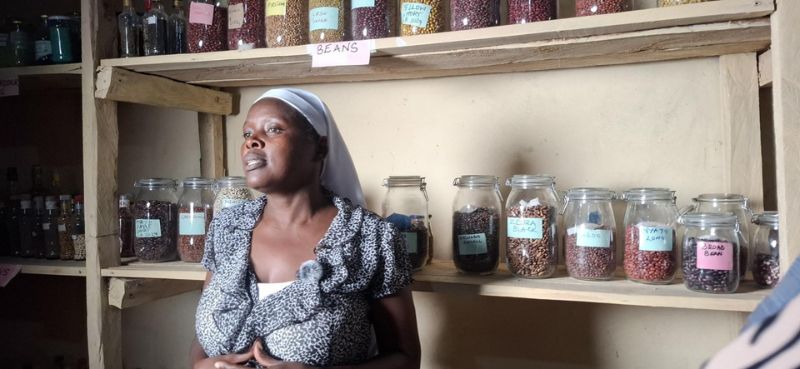
According to the Kenya Plant Health Inspectorate Service (KEPHIS), the country has lost over 30 percent of local seed varieties in the last three decades due to climate change, commercialization of agriculture, and shrinking farm sizes. “We have eight varieties of indigenous maize, 18 types of sorghum, seven finger millet varieties, and 15 types of traditional leafy vegetables,” Evelyn Okoth, Chairlady, Agoro Kabudi Community Seed Bank explained. “For beans alone, we have 69 varieties, and we are adding two more to reach 71.”
Okoth said the seed bank which is fully women-owned, was launched in 2021 with support from the Alliance for Seed Diversity through KALOFADA. It was born out of an urgent need to preserve indigenous crops that are disappearing across Kenya.
Research shows that indigenous crops can tolerate drought up to 40 percent better than commercial hybrids. Yet many of these crops risk extinction as farmers shift to fast-growing hybrids Okoth and her team are trying to reverse that trend by embracing organic farming and local innovation.
“The seed bank members have fully embraced organic agriculture. We make our own biopesticides and biofertilizers. Nothing we use here is synthetic,” she said.
The group sells these natural inputs to farmers at affordable prices, helping reduce reliance on chemical fertilizers whose costs have risen by more than 70 percent since 2021, driven by global price shocks and fertilizer shortages.
To guarantee seed availability, the seed bank runs a unique lending model. “If a farmer takes one kilogramme of seed, they return two kilogrammes after harvest,” said Okoth. “This way, the community helps us multiply varieties, we cannot manage alone.”
This model mirrors farmer-managed seed systems across Africa that supply 60 percent to 80 percent of all seeds planted, according to the Alliance for Food Sovereignty in Africa (AFSA).
With many widows and single mothers depending on farming, the group introduced value addition to raise incomes. “We produce flour, baby porridge, adult porridge, fermented and non-fermented,” she said. “We even have a special porridge for people struggling with low libido.”
She added that they also process dried vegetables, a preservation method that helps reduce post-harvest losses, which FAO estimates at 30–40 percent for vegetables in Kenya. Machines for drying, winnowing, cleaning, and threshing have eased the physical burden once borne by women and improved hygiene standards.
Seed quality assurance is central to their operations. Okoth said they use both traditional and modern methods ash, crushed bricks, zeolite beads, and airtight jars from ICARDA, to keep seeds dry and pest-free.
They also conduct germination tests, only accepting batches with 80 percent germination rates or above, aligned with national quality standards for seed viability. But climate change remains their biggest threat. “The drought has been terrible,” Okoth says. “Even our indigenous seeds which usually survive harsh conditions have failed. We fear losing many varieties.”
According to the Kenya Meteorological Department, the Lake Victoria Basin has experienced three consecutive failed rainy seasons, with average rainfall reducing by 25–40 percent since 2020. In 2023 and 2024, Kisumu and neighbouring counties recorded some of the worst crop failures in a decade. “Many farms have completely dried up,” she said.
The group also faced legal restrictions under Kenya’s previous seed laws, which limited the sale and exchange of uncertified seeds. A recent court ruling in favour of farmer-managed seed systems gave them relief. “It was a great day for us,” said Okoth. “But we still need a clear strategy for certifying our seeds so we can sell them legally and earn real income.”
She hopes for a future where indigenous seed conservation is recognized as part of Kenya’s climate adaptation strategy.
“Some African leafy vegetable seeds cost up to Sh3,000 (US$ 23) per kg. If we can produce on a large scale, we can support our families and preserve our heritage,” she noted.
She pointed out that they use ash preservative, as a traditional, low-cost method of keeping pests at bay, and added that their seeds are safe because pests fear dust. “This is our indigenous knowledge. It works,” she said.
Okoth concluded that for the women of Agoro Kabudi, conserving seeds is more than farming. “It is a fight to protect Kenya’s food future, one jar of seed at a time,” she said.