


By Agatha Ngotho | angotho@gmail.com
Edible insect research is gaining momentum across Africa as scientists explore sustainable ways to boost food and nutrition security.
In Kenya, institutions such as the International Centre of Insect Physiology and Ecology (icipe) and Jomo Kenyatta University of Agriculture and Technology (JKUAT) are at the forefront of research on insect farming, processing and commercialization as alternative protein sources.
According to icipe, its Insects for Food, Feed and Other Uses (INSEFF) Programme is advancing innovative research under the One Health framework to address interconnected challenges affecting human, animal, plant and environmental health. The programme promotes sustainable insect-based technologies aimed at improving food and feed security while boosting the economic wellbeing of smallholder producers.
“Through low-cost and improved solutions, INSEFF supports the mass rearing and safe harvesting of edible insects such as crickets, grasshoppers, palm weevils, mealworms and black soldier flies, enhancing productivity, value addition and livelihoods,” icipe says.
Research findings from JKUAT show that insects offer multiple benefits that make them critical to food sustainability. Rich in protein, vitamins and minerals, insects present a viable solution to malnutrition and food insecurity, particularly in regions where conventional livestock farming is impractical.
Dr John Kinyuru, Principal Investigator of the HealthyInsect Project, notes that insects have long played important roles in ecosystems, diets and human culture, with more than 500 species contributing to food and nutrition security across Africa. However, he says it is only in recent years that insects have begun to be recognised as a form of “novel livestock” within modern food systems.
“Research and innovation have surged, fostering a growing public–private sector. Insects, especially farmed species, efficiently convert organic residual streams into high-value products. As a result, they hold immense potential for sustainability, a circular bio-economy and improved livelihoods,” Dr Kinyuru says.

South Africa is following closely. At the University of Pretoria, researchers are investing heavily in insect-based foods and exploring opportunities for large-scale production.
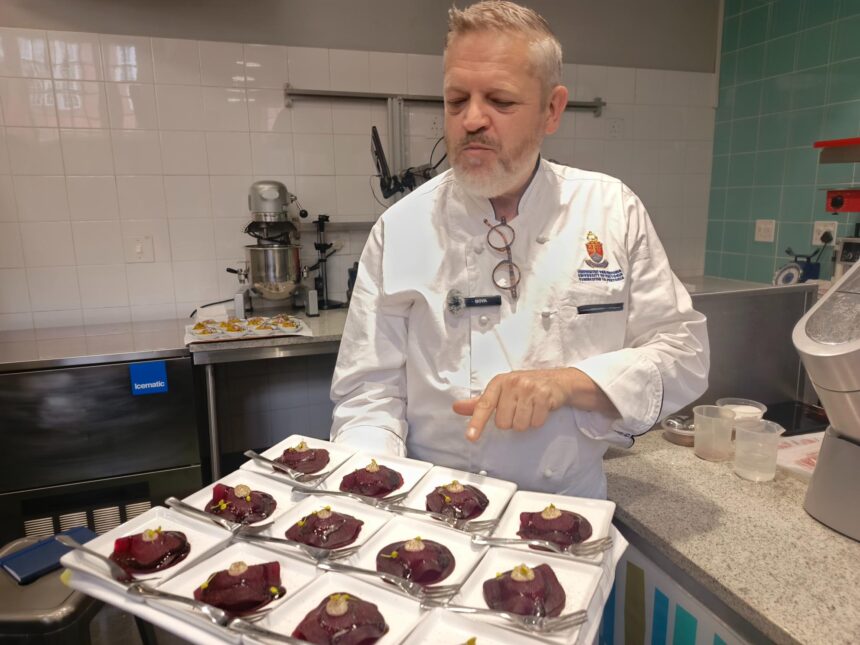
During the World Conference of Science Journalists (WCSJ) 2025 held from December 1-5 in Pretoria, visiting science journalists sampled products at the university’s laboratories made from cricket flour, an experience that showcased the growing potential of insect-based foods to support healthier diets, create new agribusiness ventures, and promote sustainable food systems across the continent.
Prof Ahmed Yusuf, from the Department of Zoology and Entomology at the University of Pretoria, said their research focuses on developing cheaper, sustainable methods for rearing insects for both food and feed.

“We’re working mostly on house crickets and dengue virus mites, which have been used in food and feed. The insects have a high amount of nutrients, especially proteins, lipids and vitamins,” he said.
He noted that insects offer near-total utilization.
“One of the advantages of insects is that almost everything in them is useful. When you compare them to other sources of protein like meat, where bones and other parts are not used, insects are much easier to rear.”
Prof Yusuf added that insects require minimal space and water, making them highly efficient in protein production. “If you make an equivalent amount of protein, the resources needed for beef are much higher than for insects. This is important on a continent where we’re trying to conserve resources,” he said.
He explained that insects can also help reduce land-use conflicts. In Kenya, the demand for animal feed is high, yet feed costs account for nearly 70 percent of production for dairy, pig, and poultry farmers.
“Kenya already has legislation allowing the use of insects for food and feed. In South Africa, we’re not there yet, so we learn from Kenya. Kenya has set the example because companies rearing insects are already emerging,” Prof Yusuf said.
Beyond rearing, researchers are now analysing insect proteins more deeply. “We are looking at extracting proteins to understand what they are made of and whether we can produce such proteins more efficiently,” he explained. In addition to proteins, insects provide valuable lipids, including oils comparable to olive oil.
At the same department, Frederich Henneke, a Control Technical Assistant and master’s student researching edible insects, is studying food safety.
“We looked at the total number of bacteria and the types found in crickets,” he said. “There isn’t specific legislation on edible insects or what bacterial limits are safe. When we compared crickets to minced meat, we found higher bacterial counts because you eat the whole insect, not just muscle tissue. It’s not a deal-breaker, it just means crickets cannot be sold raw.”
Prof Mohammad Naushadi Mambax from the Department of Consumer and Food Science said their work applies a farm-to-fork and fork-to-farm approach centred on consumer needs.
“We take consumer advice seriously and transmit those needs to producers, mostly farmers,” he said.
The department develops insect protein concentrates and isolates that can be used in food applications such as meat analogues, and also in high-efficiency animal feeds.
“Insects face challenges like neophobia, the fear of eating insects. We turn them into powders or isolate that can be used in different products,” he explained.
Prof. Mambax pointed out the importance of insects for Africa’s nutrition future.
“Insects are affordable sources of protein, and protein is limited in sub-Saharan Africa. Food and nutrition security is a wicked problem that needs a multidisciplinary approach. Here at the University of Pretoria, we address the entire food value chain from production to consumption.”
On quality control, he said they use established methods similar to those used for pea or soy protein isolations. “We also test for microbiological safety and heavy metals to ensure the products meet South Africa’s Food, Cosmetic and Disinfectant Act.” “The biggest limitation is accessing raw materials at an affordable price,” he said.