

By Isack Dickson | isackdickson11@gmail.com
In the land of Simanjiro, in Tanzania’s Manyara Region, the sun has ceased to be a farmer’s friend and instead has become more scorching than nurturing.
Here, climate change is not just an academic concept discussed in conference halls; it is a bitter reality that cracks the earth and dries up the channels of life.
However, amid this gray dust, green is sprouting—thanks to the strength of women’s hands who have decided to conquer their fate through irrigation science and alternative technologies.
When the Problem Turned into Opportunity
For many years, rain-fed agriculture has been a risky gamble for the residents of Simanjiro.
Vaileth Kadogo, one of the prominent farmers in the area, recounts the despair that existed before the Tanzania Conservation and Community Empowerment Initiative (TACCEI) project reached them.
“It was really very difficult before we started farming these irrigated fields,” Kadogo narrates.
“I used to farm only maize, but the challenges were many. I faced issues with goats eating my crops and the intense sun scorching all the maize in the field. It was tough, but we kept enduring.”
Kadogo is part of a group of 111 women from five villages: Terrat, Engonongoi, Loswaki, Loibor-Siret, and Embore—who have decided to stop complaining and start acting.
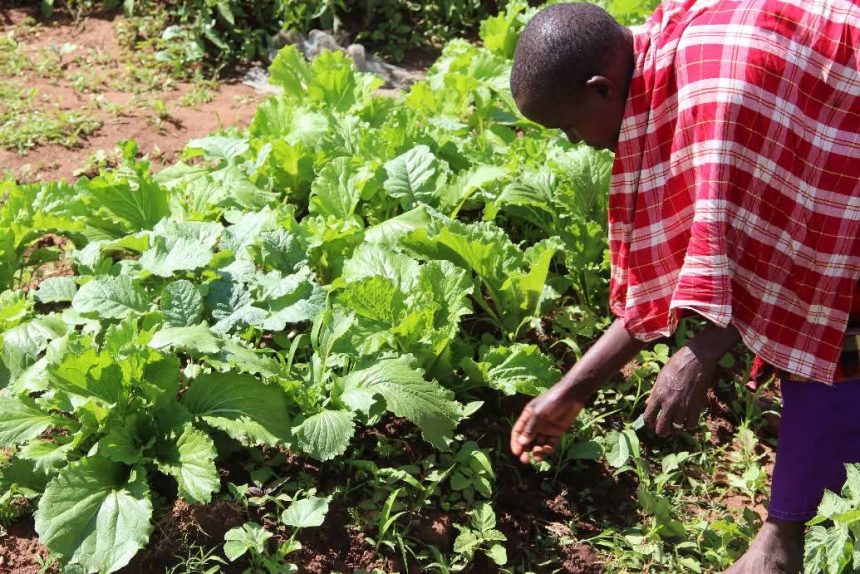
Through irrigation, these women are now producing vegetables like cabbage, Chinese cabbage, spinach, and even cassava—crops that were previously considered a dream in this arid land.
This revolution has not only changed the appearance of the fields but has also brought major social and economic transformations. Elisha Saiboku, Kadogo’s husband, is a witness to how agricultural science has saved the dignity and economy of his family.
“This farm is what sustains the family right now. The children are studying because of this farm,” says Saiboku. “We don’t worry about buying vegetables.
We get everything right here on the farm. So, from family nutrition to the children studying, it’s all because of this farm.”
Esther Eddi, another participant in the project, points out that this kind of farming has become an economic savior for rural women, giving them financial independence that they previously lacked.
“This farming helps me a lot because when I get money, I educate my children, buy food for the family, and sometimes I save some and increase my capital so that the project can grow bigger,” explains Eddi.
The Science of Drops: Simple Technology, Great Productivity
According to Yohan Meliyo Mollel, TACCEI’s Public Relations officer, the organization is focused on uplifting women economically through irrigation agriculture because during the dry season, they lack work to do.
“During the dry season, there is no milk, and if there is no milk even the diet in the villages becomes unbalanced.
Recognizing the difficult circumstances in which some women live, we help establish vegetable gardens such as cabbage, spinach, and nettle to improve family nutrition and ensure food security in the homes,” says Meliyo.
TACCEI provides professional training through agricultural experts who teach women the best methods of preparing seeds, ridges, and the correct use of fertilizers.
The training also includes the production of natural pesticides to protect consumer health and avoid industrial chemicals. For the project to be successful, the organization considers specific criteria such as the availability of water near agricultural areas and the provision of nets to protect crops from birds.
“The women have sold their vegetables and have even started using them in their homes. They buy clothes for school children, notebooks and small household items,” he says.
“The results of these efforts have become noticeable in large numbers in villages like Loswaki and Terrat, where women have been able to earn additional income from selling vegetables.” Kadogo now irrigates carefully using watering cans, tracking her water use to maximize efficiency.
“When I combine with other vegetables, I can earn up to 15,000 to 30,000 shillings (US$ 6-12) per day,” she says.
Scientifically, irrigation farming removes the uncertainty of rainfed agriculture that has made farmers incur losses over the years.
“There are several benefits of irrigation farming. First and foremost, with irrigation, you have certainty of harvesting.
If you were supposed to get 35 sacks, you are assured of getting them because you don’t depend on rain,” explains Festo Richard Silungwe, a lecturer from Sokoine University of Agriculture (SUA).
“The second benefit is the ability to plan your affairs; you can plan what to plant, starting from which date, and when to harvest.”
Government Efforts and the Africa Agenda 2063
These efforts in Simanjiro are an example of the implementation of the African Union’s Agenda 2063 and the Sustainable Development Goals (SDGs), especially Goal 5 on gender equality.
The Tanzanian government has set a strategy to increase irrigated land to 1.2 million hectares by 2030.
Jackson Matery, Councilor of Terat Ward in Simanjiro District, Manyara Region, confirms that the government is equally interested in these rural innovations.
“Under the guidance of President Samia Suluhu Hassan, we have started doing borehole projects and irrigation trials in Loswaki village and other areas. The goal is to ensure ordinary citizens benefit from existing resources to bring economic development,” says Councilor Matery.
Despite challenges such as rodent infestation and the low level of education of some participants, Meliyo notes that TACCEI continues to provide close consultation including visiting the women in their homes or farms, while continuing to look for more donors to expand the scope of this project to more villages.
The women of Simanjiro have proven that through the use of simple technology, scientific education, and courage, it is possible to turn arid land into fertile ground.
The Africa we want begins with a woman irrigating her garden with hope and victory, knowing that every drop of water is a step toward economic freedom.
This story was first aired on Orkonoorei Fm- Tanzania