


By Sharon Atieno | sharonphoebeatieno@gmail.com
African countries are making strides to tackle problems being caused by use of plastics amidst a background of global efforts underway to develop an international legally binding treaty to address the menace.
The United Nations Environment Programme (UNEP) estimates that more than 400 million tonnes of plastic are produced annually worldwide, with half of it being designed to be used only once (single-use plastics).
More than 30 countries in Africa have intensified action against this type of plastic including imposing bans or levies. Kenya, for instance, implemented a ban on single-use plastic bags with significant fines and jail terms for violations.
Beyond imposing bans, countries are moving towards non-plastic alternatives and substitutes in a bid to promote the circular economy.
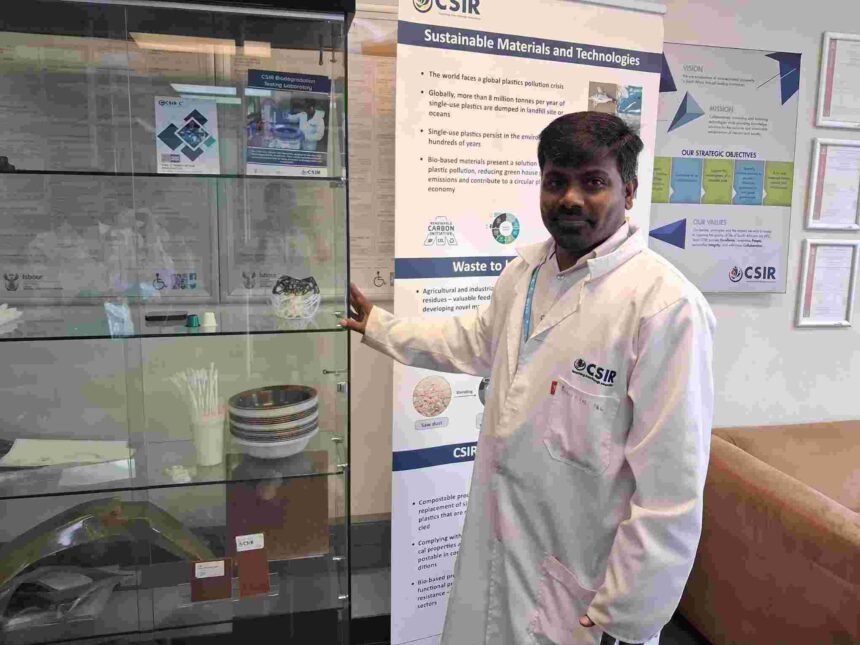
South Africa, particularly, through its Centre for Scientific and Industrial Research (CSIR), is fostering the development of sustainable alternatives to plastics.
The country generates about 2.4 million tonnes of plastic waste annually, equivalent to 41 kg per person per year, which is higher than the global average of 29 kg per capita per year. Of this, only 14% is recycled, and around 40% of this waste is mismanaged, while three percent directly leaks into the environment.
According to Dr. Sudhakar Muniyasamy, Principal Scientist, CSIR, the facility is developing eco-friendly material using local biomass available in the country. These include agricultural waste such as sugar cane bagasse, maize stock residues and other organic waste.
Highlighting that they are developing polymers from these organic waste, he notes that these products contain chemical components that are not harmful to the environment.
“Biodegradable products can replace conventional plastics, which take more than 100 years to degrade,” Dr. Muniyasamy stressed.
He was speaking during a field trip to the facility during the 2025 World Conference of Science Journalists in Pretoria, South Africa. The conference ran from 1st-5th December, 2025.
According to Dr. Muniyasamy, the agricultural sector is one of the biggest beneficiaries of this new technology. For instance, the researchers are developing a biodegradable mulching film to replace the plastic mulching film, which entails using a plastic film to cover plants to control weeds, retain soil moisture, and regulate soil temperature. This is mostly used in growing strawberries, pineapples and tomatoes.
Dr. Muniyasamy notes that conventional plastics break into pieces after harvesting, leading to environmental contamination. However, with the biodegradable products, it will take a shorter time to decompose while enhancing the soil fertility because it is a natural product.
Some of the CSIR developed prototype products include compostable biomedical devices, biodegradable mulch films, bio-based cutlery, and bio-based components for transport sector.
Besides, the CSIR facility houses Africa’s only laboratory equipped to test and verify produced products that are being fronted as biodegradable. Funded by the Japanese Government, through the United Nations Industrial Development Organization (UNIDO).
According to Dr. Muniyasamy, the primary purpose of the testing facility is to verify whether a material is eco-friendly, how long it takes to degrade, and if any toxic substances leach during biodegradation.
The laboratory also aims to support industry, local manufacturers, and universities by verifying claims about material biodegradability and ensuring materials meet international standards.
Tests can be performed under different conditions: aerobic (compost, soil, fresh and marine water) and anaerobic.
Besides, Ghana has developed a five-year implementation plan to reduce plastic packaging and make sustainable alternatives more commercially viable. It targets the country’s most waste-heavy sectors such as plastic mulch-film, sachet water packaging and carrier bags.
The East African Community is also in the process of drafting a regionally binding roadmap to phase out single-use plastics. Part of the bill calls for incentivizing sustainable materials.
Plastic pollution leakage into aquatic ecosystems has grown sharply in recent years and is projected to more than double by 2030, with dire consequences for human health, the global economy, biodiversity and the climate.
Greenhouse gas emissions from plastics in 2015 were 1.7 gigatonnes of CO2 equivalent (GtCO2e), and are projected to increase to approximately 6.5 GtCO2e by 2050, or 15 percent of the global carbon budget.
A drastic reduction in unnecessary, avoidable and problematic plastic is crucial to addressing the global pollution crisis, UNEP cautions.