

By Addy Rossi
Between October 14 and 18, 2025, Nairobi became the global epicenter of agricultural journalism. More than 180 agricultural journalists from five continents gathered in Kenya’s capital for the International Federation of Agricultural Journalists (IFAJ) Annual Congress, organized in conjunction with MESHA (Media for Environment, Science, Health and Agriculture), Kenya’s network of science journalists.
Under the theme “Unlocking the agricultural potential in the cradle of mankind”, the event marked the first time the congress had been held in East Africa and only the second time on the continent since 1952: a symbolic gesture of repositioning Africa not only as a setting for rural stories, but also as a generator of innovation, research, and its own agenda.
A congress that was also a political message
The congress announcement itself had already made the tone clear: Nairobi was presented as a city of “fresh water” and a strong agricultural research network, with institutions like ILRI, the World Agroforestry Centre, and ICIPE acting as global scientific hubs.
The official narrative emphasized four objectives:
- Strengthen MESHA as a regional and global player in scientific and agricultural communication.
- Increase the visibility of Kenyan agriculture, focusing on key sectors such as tea and cut flowers, two of its main exports.
- Promote exchange among journalists, scientists, and businesses on topics such as seeds, biologicals, digitalization, and climate change.
- Attract investment and trade to the country’s agri-food sector..
Various reports — from Kenyan portals to global organizations in the seed and animal nutrition sector — highlighted that Kenya “made history” by hosting this congress, both for the scale of the meeting and for its symbolic weight: a global federation of rural journalists who choose to look at Africa from Africa, instead of talking about Africa from other latitudes.
Program, structure and central theme
The congress took place between October 14 and 18, combining:
- Plenary sessions on food security, agricultural innovation, solutions journalism and the role of the media in rural transformation.
- Thematic panels co-organized with sector actors, such as the International Seed Federation (ISF), AFSTA and seed companies, focusing on seed quality, regulatory frameworks and technological adoption by small producers.
- Workshops and breakout sessions on journalistic innovation, digital storytelling, science and climate coverage, and how to connect with young rural audiences.
- Field and company visits: tours of tea farms, flower producers, biocontrol and bio-input ventures, and research centers.
The official website of the congress defined Nairobi as the gateway to African agricultural innovation, and presented the motto as an invitation to view the continent as a living laboratory of solutions in seeds, biologicals, infrastructure, trade and climate resilience.
Topics that shaped the agenda
If one reviews the reports and press releases published after the congress, certain thematic axes are repeated that seem to have set the tone of the meeting:
1. Quality seeds and rural transformation
A significant portion of the agenda focused on the role of seeds as drivers of productivity, climate resilience, and market development. The ISF and partners such as East-West Seed, Rijk Zwaan, and Corteva organized panels and roundtables to discuss how regulatory frameworks, intellectual property, and public-private research can generate real impact on the lives of farmers.
An article by the International Seed Federation described one of the sessions as a “journey” through the stories of farmers gaining access to hybrid or improved seeds for the first time, and how this translates into increased income, employment, and the revitalization of rural communities.
2. Biologicals, innovation and sustainability
Another key theme was the advancement of biocontrol agents and bio-inputs. The company Andermatt, for example, highlighted in its coverage that the congress brought together some 180 journalists from 34 countries and emphasized the importance of connecting journalism, innovation, and more sustainable solutions for pest and disease management.
The message there was clear: it’s not just about showcasing “new products,” but about explaining new production systems and helping audiences understand why the transition to more regenerative practices is not just a trend, but an economic, environmental, and social necessity.
3. Women changing agriculture
One of the most cited articles came from Food For Mzansi, which focused on the women driving transformations in Kenyan agriculture. It cited data from the Kenya Agricultural and Livestock Research Organisation (KALRO) showing that women now outnumber men in crop production, reshaping the landscape of who makes decisions, produces, and leads in agriculture.
The article also included the perspective of Aghan Daniel, secretary of MESHA, who interpreted the organization of the congress not only as a logistical achievement but also as recognition of the network’s track record in promoting science and gender equality in agricultural coverage.
4. Youth, leadership and the future of the trade
The articles dedicated to the IFAJ–Alltech Young Leaders program emphasized one idea: agricultural journalism only has a future if it can incorporate new voices, new platforms, and new narratives.
Reports from Africa and Latin America highlighted:
- The combination of workshops on podcasting, visual storytelling, and public policy coverage.
- The emphasis on leadership, negotiation, and project design skills, in addition to the core journalistic craft.
- The idea that young people are not just “beneficiaries” of programs, but partners in shaping IFAJ’s global agenda.
5. Companies and sponsorships with their own narrative
There was no shortage of articles written by sponsors. Alltech, for example, presented the congress’s closing as a celebration of “hope and global unity in agricultural journalism,” emphasizing the need to build bridges between science, business, and the media to address challenges such as climate change, animal nutrition, and food security.
These corporate pieces, far from being mere press releases, provide useful data: number of delegates, countries represented, session topics, and also demonstrate how companies seek to position themselves as partners in the public conversation about the future of agriculture.
Nairobi as an open classroom: field trips
Technical visits featured prominently in many reports. Texts from companies, organizations, and journalists all shared three key ideas about the “open classroom” that Kenya offered:
- Productive diversity: from small producers to large export-oriented agribusinesses, including mixed projects that combine subsistence farming and market access.
- Innovation in a context of climate vulnerability: efficient irrigation, genetic improvement, integrated pest management, and low-cost digital technologies.
- Rural-urban connection: Nairobi’s role as a logistics, financial, and media hub for an agricultural hinterland that extends its reach to Africa and the world.
For many journalists, the experience of seeing tea plantations, flower greenhouses, or biological solutions in use firsthand was just as, if not more, powerful than the hotel presentations. That’s where the congress’s motto—unlocking agricultural potential—ceased to be just a slogan and transformed into images, interviews, and future reports.

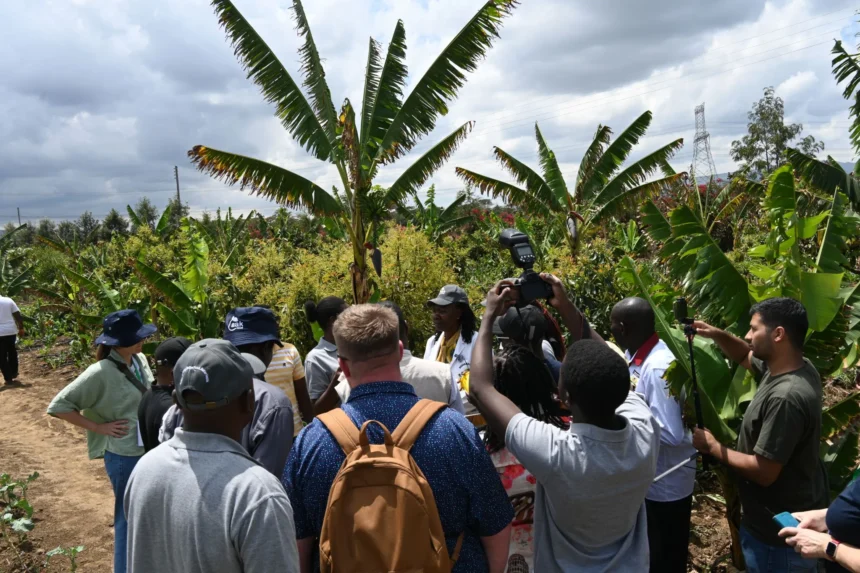
Farmer Anastacia Ngarama (in grey hat) leads a tour of her farm and describes how CropLife International’s Sustainable Pesticide Management Framework fits into her operation on a Congress tour in September near Naivasha, Kenya.

IFAJ journalists tour the Kenya Agriculture and Livestock Research Organisation (KALRO) center in KALRO to learn about development in dairy, poultry, pigs and crops.

Adrian Bell of the UK shares the magic of photography with youngsters at the Nyara Tea Estate.

Ulan Eshmatov addresses the 2025 IFAJ Delegate Assembly as his guild, the Kyrgyz Agricultural, Science, and Environmental Journalists Association (KAIEJA), is welcomed as an IFAJ member.

Ending the final 2025 Congress banquet, the Kenyan Congress organizing committee leads the handover of the IFAJ flag to next year’s hosts from Croatia.