

By Seif Gracien Hasingizwimana | hasingizwimanashaggy@gmail.com
Six years ago, just after sunrise, Mariana Mukandungutse, a member of the Abadasobanya Farmers Group, stood at the edge of her field in Gashora Sector, Bugesera District, hopeful that the new planting season would bring change.
The soil was dark and soft from the previous day’s work. She had saved seeds, measuring each handful carefully as she placed them into the ground.
The optimism did not last. Once again pests known locally as Mukondo w’inyana had invaded her field, consuming the seeds before they could germinate.
The pests, small millipedes, were long considered harmless by farmers because they fed on organic matter beneath the topsoil. However, scientists explain that under certain conditions, including low soil organic matter and reduced moisture, the pests can become destructive crop pests.
During drought, the millipedes move closer to the surface in search of water and decomposing material, and in the process attack crops’ roots and newly planted seeds. Farmers are advised to apply well decomposed compost or manure and to irrigate regularly to prevent infestations.
Mariana had not accessed this knowledge at the time, and this cost her. “I was expecting to harvest 200kg of maize, but because of dry spells and pest invasion, I suffered losses,” she said, adding that her vegetables were not spared by a different kind of pest.
The problem extends beyond Bugesera. In 2022, farmers in Gatsibo District reported that more than 400ha of crops were destroyed by Mukondo w’inyana.
At least eight sectors; Ngarama, Murambi, Kabarore, Rwimbogo, Kiramuruzi, Gatsibo, Kiziguro and Rugarama, were affected.
The United Nations Food and Agriculture Organization (FAO) estimates that annually up to 40 per cent of global crop production is lost to pests. Climate change is set to worsen the situation.
Rising temperatures are set to increase the risks of pests spreading and changing migratory routes and geographical distribution.
The fall armyworm, for instance, is native to the Americas. However, since 2016, it has spread all over the sub-Saharan Africa. It is estimated to reduce maize production by up to 53 per cent, according to a 2024 review titled: “Cereal production in Africa: The threat of certain pests and weeds in a changing climate — a review.”
According to Aimable Gahigi, the Director General, Rwanda Meteorological Agency, rising temperatures are making rainy seasons shorter and more intense. The number of rainy days has declined by between 35 and 45 days per year due to climate change, he said.
Despite this, a shift is happening in Rwanda. Smallholder farmers, including women, are embracing climate smart agriculture to cope with the unpredictable weather patterns and negative impacts of climate change.
This kind of agriculture involves better seed handling and nursery bed preparations, small-scale irrigation, using local materials for mulching and manure production, effective pest and disease management and sustainable agronomic practices among others.
Embracing climate-smart agriculture
It is six years since Mariana opted for climate-smart agriculture. She follows modern practices such as clearing fields, minimizing soil disturbance and digging planting holes, which helps her to manage pests better.
“After digging holes, we add organic fertilizer, then chemical fertilizer according to extension officers’ guidelines, and finally plant the seeds,” Mariana said, adding that they use watering cans for irrigation.
However, this is physically demanding and time-consuming, as work that can be done in one day may take two.
Her husband helps with farm work and transporting produce to the market by motorcycle.
Since adopting climate-smart agriculture, Mariana says her life has changed significantly. “Before, I lived in a rented house and leased the land I farmed. Today, I own land,” she says.
She owns a house worthRwf 8 million ($5,400), having started with capital of Rwf 300,000 about ($200). “I left casual farm labour that paid Rwf 1,000(about a dollar) per day. I borrowed Rwf 60,000($42) from my savings group and added my own savings. Altogether, I had Rwf 300,000 ($200),” she said.
From this, Mariana spent Rwf 200,000($140) to lease five terraces, bought seeds worth Rwf 50,000 ($30) and fertilizer worth Rwf 30,000($20).
“This farming helps us to feed our households and supply the market. Every day, I sell 300 bundles of vegetables and 100 bundles of spinach. One maize cob sells for Rwf 200(about a dollar),” she said.
Divine Umuhoza, a tomato farmer in Nyamata Sector, uses compost manure and chemical fertilizers, applying them in the planting holes to help with moisture retention. She plants trees along the edges of her farm to absorb runoff water.
She also carries out small-scale irrigation, though sometimes it is a challenge. “We lack water-pumping machines to move water uphill,” she said, adding that renting a pump was expensive. “If fuel costs Rwf 2,000(about a dollar) per litre and you use five litres, that’s about seven dollars. Recovering your investment becomes very difficult.”
This kind of agriculture has enabled her to buy two head of cattle and three pigs. She built a Rwf 20 million ($13,700) house, saved money in the bank and paid for health insurance. Adelphine Tuyisenge, the president of the Abadasobanya Savings Group in Nyamata Sector, said her group focuses on vegetables after receiving training in modern farming.
Using watering cans for irrigation and proper division of their fields has helped to achieve sufficient harvests and increased their understanding of the importance of organizing their farm.
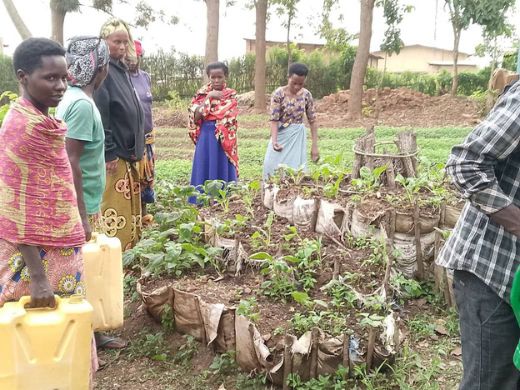
For an investment of Rwf 100,000 ($70 to buy seeds, prepare the land and purchasing other farm inputs, the group can get a profit of Rwf 200,000 ($140) after harvest.
Dr Abias Maniragaba, an agricultural researcher, states that climate-smart agriculture reduces erosion, conserves natural resources, and strengthens resilience. It empowers women, who often lack financial resources, knowledge, or decision-making power, all which benefit their families.
“Climate-smart agriculture greatly increases production when research, cooperatives and government support are combined. Quality seeds increase farmers’ ability to cope with climate variability, while agricultural training linked with women’s skills development improves sustainable land use. Sharing knowledge on pests and climate adaptation enables climate-smart agriculture to provide high yields and improve family food security,” he explained.
Eugene Kwibuka, the Agriculture Information and Communication Programs Manager at Rwanda’s Ministry of Agriculture and Animal Resources (MINAGRI), notes that climate-smart agriculture helps the country to address climate challenges by building resilience, increasing productivity, and reducing environmental impact.
“It protects farmers from droughts, floods, and soil erosion through improved land and water management, boosts yields with climate-resilient crops and efficient irrigation, and supports climate mitigation through practices that lower greenhouse gas emissions and promote sustainable livestock systems.”
The African Union (AU) strongly advocates for climate-smart agriculture as crucial for food security, resilience and development, guiding implementation through frameworks such as the Africa Climate-Smart Agriculture Implementation Plan (CSAIP 2022-2032). This framework guides countries in developing climate smart agriculture policies, strategies and financing systems to transition to resilient farming.
The fifth Rwanda’s Strategic Plan for the Transformation of Agriculture (PSTA5) aims to accelerate agricultural transformation through increased climate resilience, productivity, market access, and private sector investment, with the overarching goal of ensuring food security, economic growth, and improved livelihoods. Climate smart agriculture is one of the ways of achieving this.
The strategy targets women-headed households and young people in agriculture, recognizing that these groups face unique challenges but also represent significant potential for agricultural transformation.
According to Kwibuka, women farmers in Rwanda are supported to adopt climate-smart agriculture through access to climate-resilient seeds, subsidised inputs, and strong institutional support from the Rwanda Agriculture and Animal Resources Development Board (RAB) and cooperatives.
They receive practical training through national agricultural projects, gain access to loans, grants, and subsidized crop insurance, and benefit from savings groups and affordable irrigation technologies. Improved storage and post-harvest facilities further help reduce losses and increase farm incomes.
He said poverty reduction was equally significant, as efficient input use through techniques such as fertilizer deep placement and water-smart irrigation reduces production costs.
“The stable income generated enables parents to pay school fees and reduces the need for child labour during difficult periods, thereby improving children’s access to education.
Time-saving technologies and efficient irrigation systems free up women’s time for other income-generating activities or family care, while improved climate resilience results in fewer hunger periods and less need to sell household assets during emergencies,” Kwibuka said.
The Land Husbandry, Water Harvesting and Hillside Irrigation Project serves as a compelling example, having benefited 2,689 households and more than 100,000 people, with women forming the majority of cooperative members across an estimated area of 12,940 hectares.
Furthermore, the Sustainable Agricultural Intensification Project (SAIP) recognizes women’s crucial role in agricultural production, food security, and household nutrition, acknowledging that gender equality reduces poverty and benefits entire communities. The project ensures that at least 42 per cent of beneficiary households, approximately 84,000 out of 200,000 beneficiaries, are women, with emphasis on their participation and leadership in self-help groups and cooperatives.
These efforts geared towards empowering women in agriculture align directly with the United Nations Sustainable Development Goals (SDGs).
SDG five focuses on gender equality advocating for equal rights for women to economic resources while SDG two focuses on zero hunger which calls for doubling productivity and incomes of small-scale food producers.
“When properly supported and targeted towards women and smallholder farmers, as these examples clearly demonstrate, climate-smart agriculture practices deliver measurable improvements in productivity, poverty reduction, gender equity, and environmental sustainability across Rwanda’s agricultural sector, creating a foundation for long-term prosperity and resilience,” he added.
This story was first published in Rwanda’s Sound of Africa