

By Juliet Akoth | julietakoth19@gmail.com
The Media for Environment, Science, Health and Agriculture (MESHA) successfully hosted its inaugural Media Awards on June 19, 2026, bringing together more than 50 participants in a virtual ceremony that celebrated excellence in science journalism across Eastern and Southern Africa.
The event attracted MESHA partners, government representatives, journalists, researchers, and development stakeholders committed to advancing accurate and impactful reporting on some of the region’s most pressing challenges. Among the distinguished guests were representatives from the International Development Research Centre (IDRC), the awards’ principal partner, and officials from the Ministry of Information, Communications and the Digital Economy.

The awards were established to recognize outstanding reporting on HIV, health, and climate change while encouraging journalists to produce research-based stories that inform public discourse and influence decision-making. Beyond celebrating individual achievements, the event highlighted the growing role of science journalism in connecting communities with evidence-based information.
In his opening remarks, MESHA Chief Executive Officer, Aghan Daniel emphasized the need for journalists to strengthen collaboration with experts working at the intersection of health, climate change and gender. He noted that the organization’s current initiative focuses on promoting knowledge translation of evidence on the nexus of health and climate change.
“We want to connect journalists with gender, health, and climate change experts and scientists to enhance partnerships and networks, which in the end will facilitate translation of relevant research for greater accessibility by policymakers, practitioners, and communities,” he said.
Aghan also urged journalists to incorporate gender equality and social inclusion into science reporting, arguing that the stories produced today will help shape public understanding and policy responses in the future.
His remarks echoed themes raised in the key address by Gender and Social Inclusion Expert Eileen Nchanji of the Alliance of Bioversity International and CIAT. Nchanji stressed that climate reporting must move beyond viewing women solely as victims of environmental shocks.
“Women are disproportionately affected by climate change, yet they serve as crucial drivers of local resilience and adaptation,” she noted. She further observed that ignoring the gender angle means missing half of the climate story and overlooking vital solutions.
The comments underscored a broader message emerging from the awards: that effective science journalism requires a multidisciplinary approach capable of linking climate change, health outcomes, gender dynamics and development challenges.
The competition attracted entries from media associations across the region, including the Health Journalists Network in Uganda (HEJNU), the Tanzania Media Women’s Association (TAMWA), JournAIDS in Malawi, the Media Science and Climate Association (MESICA) in Zambia, and MESHA in Kenya.
To accommodate diverse storytelling approaches, submissions were accepted in radio, television, online, podcast, and mobile journalism formats. Entries were submitted in either English or Kiswahili.
The competition received 56 applications. Following a rigorous evaluation process conducted by a judging panel comprising Godfrey Ombogo, Assistant Director of Communications at the Kenya National Examinations Council and former Consulting Science Editor at MESHA Science, and Rachel Kibui, Africa Media and Communications Consultant at the Alliance of Bioversity International and CIAT, the field was narrowed to 10 finalists. An additional 11 entries received special mentions for their exceptional quality.
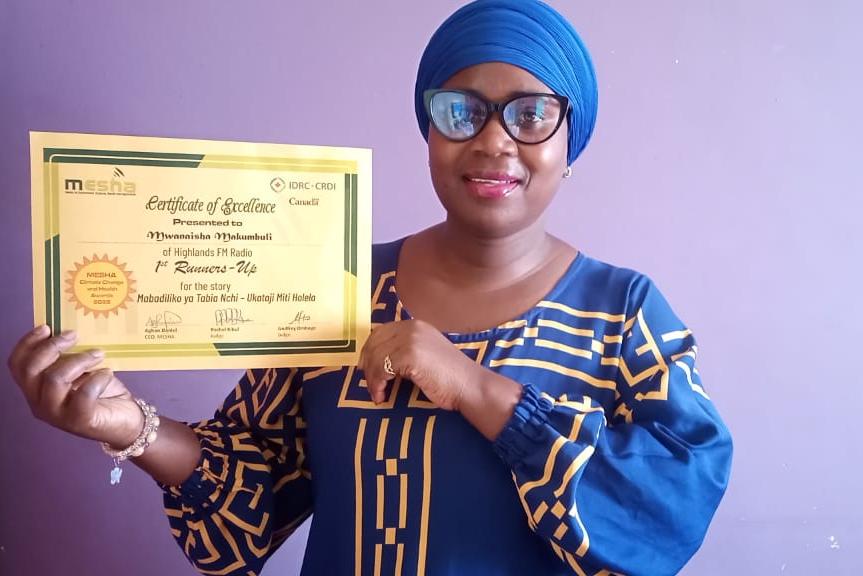
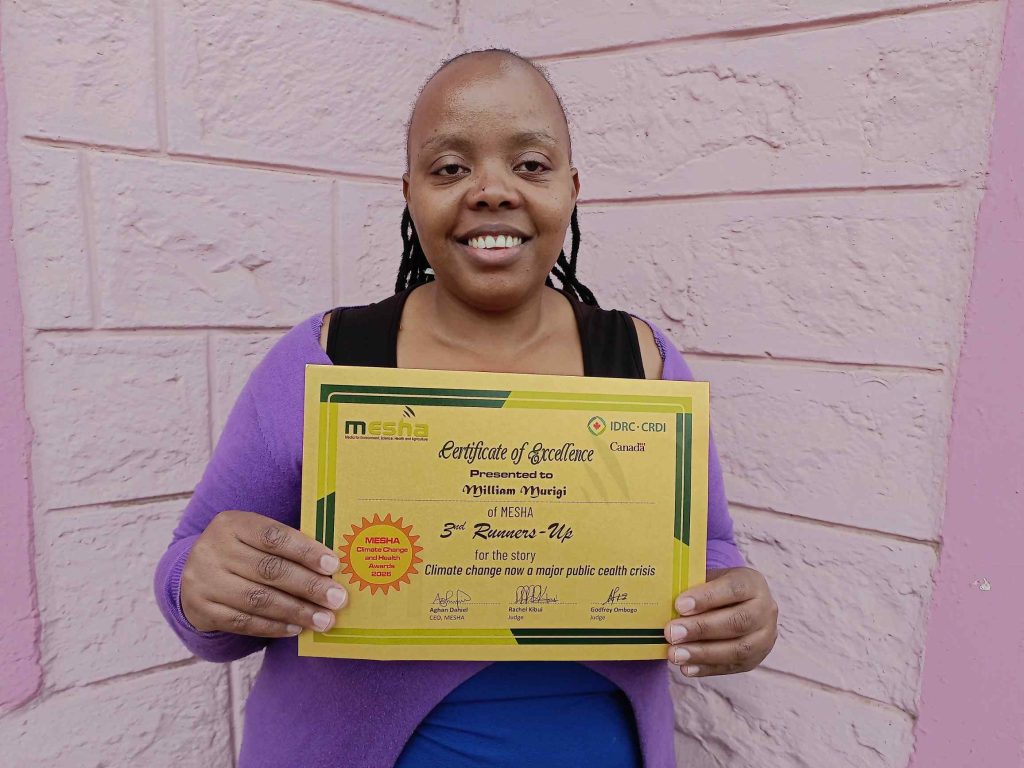
The overall winner was veteran Kenyan journalist Jackson Ambole Okata for his story, Sand Dams Are Fighting Scarcity and Diseases. The first runner-up award went to Mwanaisha Makumbuli of Highlands FM in Tanzania for Mabadiliko ya Tabia Nchi – Ukataji Miti Holela. Simon Chris Makanga of Athari Media Support Africa in Uganda emerged as the second runner-up for Forced Choices: Climate Change Rewriting Women’s Reproductive Choices in Karamoja Subregion, Uganda. While Milliam Murigi of Science Africa, Kenya, was named third runner-up for her report examining how climate change has evolved into a major public health crisis.
Other winners who featured among the top eight finalists included Asha Bekidusa, Sammy Waweru, Yvonne Kawira, and Christine Ochogo, all from Kenya.
Speaking during the ceremony, Ministry of Information, Communications and the Digital Economy representative Temesi Mukani described journalism as an essential link between science and society.
“The media serves as an indispensable bridge connecting scientific data, public understanding, and national policy formulation,” he said. Mukani challenged journalists to move beyond reporting issues in isolation and instead focus on the interconnected nature of contemporary challenges.
“We must mainstream the intersection of gender, climate change, and health,” Mukani stressed.
The awards come as MESHA prepares to celebrate its 21st anniversary in October. The milestone follows another major achievement for the association. In 2025, MESHA hosted the International Federation of Agricultural Journalists Congress in Nairobi, becoming the first organization to host the event in Eastern Africa and only the second on the African continent.
These achievements continue to strengthen MESHA’s reputation as a leading organization dedicated to supporting African journalists, promoting science communication, and amplifying African stories for regional and global audiences.
©MESHA Features 2026